

Architecture overview
This page explains how Olivares AI is structured and why. It is an explanation, not a how-to: it gives you the mental model you need to reason about the control plane before you install, configure, or extend it. For step-by-step instructions, follow the how-to guides; for exact contracts, see the API reference and the events reference.
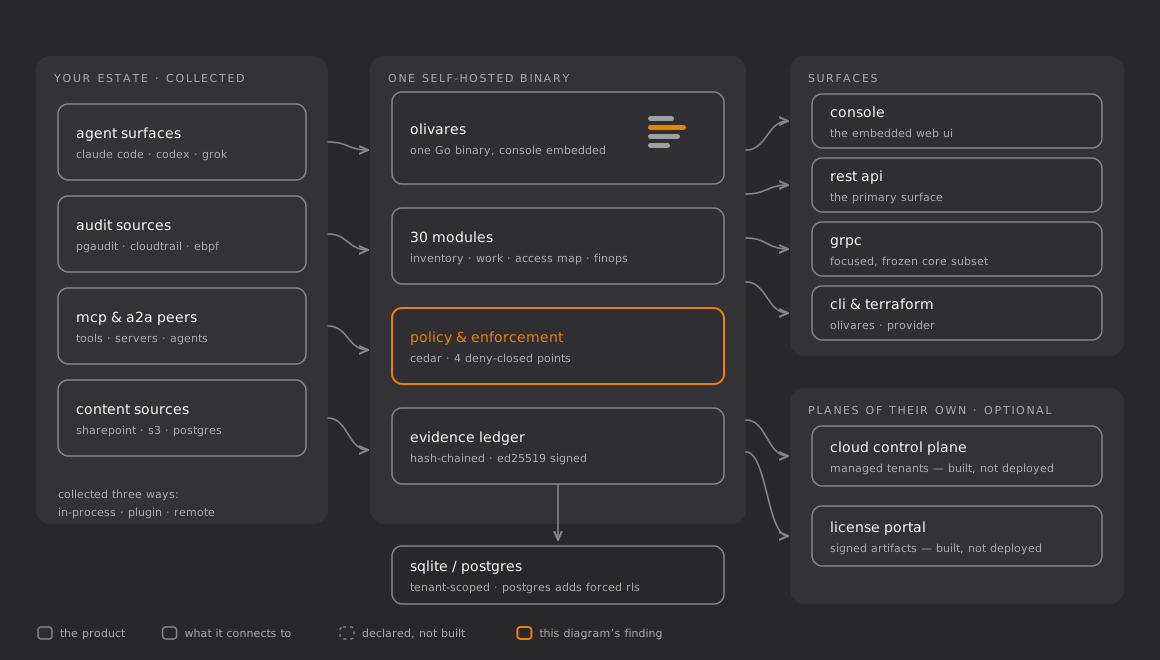
The platform model: one engine, modules, connectors
Section titled “The platform model: one engine, modules, connectors”Olivares AI is not a single-purpose tool. It is a modular platform in the lineage of Grafana, Backstage, and the Kubernetes control plane: one engine (core) plus modules plus connectors. The product spans a catalog of modules — inventory, sessions, the access map, governance, FinOps, evaluations, guardrails, and more — but they all sit on top of a single shared engine.
The architecture’s governing constraint is the “no re-architecture” rule: the engine is designed so that any module in the catalog can be added without touching the core or the other modules. Concretely, every new module:
- Consumes normalized events and data from the engine;
- Declares its own entities in the shared data model;
- Exposes its own API endpoints and UI views.
No module reaches into the internals of another, and none of them re-shapes the core to fit. The engine pays the up-front cost of being multi-tenant, event-driven, and API-first on day one precisely so that breadth can be added later without a redesign. The same principle explains the build order — CLI engine first, web on top: the CLI is the engine and exposes the full functionality over CLI and API; the web is a presentation layer over the same API, with no duplicated logic. Building the engine and then the visual face on top is not a re-architecture.
The differentiating capability — the read/write access map with the permitted-versus-observed diff — is itself a module (module III) over the shared model, not a bespoke pipeline. That is what keeps the platform honest: the flagship feature obeys the same rules as everything else.
The eight engine subsystems
Section titled “The eight engine subsystems”The engine (the core, “Layer 0”) is the set of shared subsystems from which everything else hangs. There are eight of them.
| Subsystem | What it does | Why it lives in the core |
|---|---|---|
| Ingest + event bus | Receives OTLP and connector input, normalizes it, and distributes events to modules | Modules react to events without coupling to each other |
| Connector SDK | A stable input/output connector interface — the breadth backbone | Third parties extend the platform without forking the core |
| Module runtime | Loads and runs modules: compiled in-process plus out-of-process plugins | Adds a module without re-architecting or recompiling the core |
| General data model | Multi-tenant entities and relations serving the whole catalog | One schema that all modules share and extend |
| API (REST/gRPC) + manage-as-code | All functionality over an API, plus a Terraform provider | The CLI and the web speak the same API; the panel is GitOps-able |
| AuthN/Z + multi-tenancy | RBAC/ABAC, orgs and tenants, isolation | Retrofitting permissions and tenancy is ruinously expensive — so, day one |
| Audit + integrity | Append-only, hash-chained ledger | Tamper-evidence is cross-cutting, never optional |
| License / entitlement | Offline Ed25519 license validation | Self-serve commercial, works air-gapped |
A few specifics worth calling out:
- Module runtime. Core modules are compiled into the binary; out-of-process modules and connectors run as plugins over gRPC using
hashicorp/go-plugin. This gives fault isolation and lets a module be added without recompiling the core. - Event bus. In-process by default (Go channels). The distributed binding over NATS is optional, not required — single-node deployments never touch it.
- Manage-as-code. The API is the contract of record; the manage-as-code surface adds a Terraform provider so the control plane itself can be declared and version-controlled.
- Audit + integrity. The ledger is append-only and hash-chained, with Ed25519-signed checkpoints. Entries carry a sequence number, the previous hash, the current hash, and a signature — and never carry PII. The ledger travels off-box two ways: a pull export endpoint emits CEF, LEEF, syslog, OTLP (a complete, postable export request;
otlp_envelopeis an exact alias, and the bare-LogRecord projection is the separateotlp_log_recordtoken), or OCSF, and a push — real when anaudit.recordedeventing subscription is configured — delivers each sealed record at-least-once through the durable transport. See how to forward audit to Splunk. - License. Validation is offline, using Ed25519, and the engine makes no licence call — which is what makes air-gapped operation viable. The one command that reaches out is
olivares upgrade: by default it fetches from the public repository’s GitHub releases, or from the licence worker (licenses.olivares.ai) with--enterprise— unless--endpointpoints it at your own mirror or--bundleinstalls from a carried bundle.
For the authentication and authorization details (opaque bearer tokens, first-boot setup token, the policy decision point) see the security model; they are summarized below only where the architecture depends on them.
The general data model
Section titled “The general data model”A single multi-tenant schema serves the whole catalog. Every core entity carries a tenant_id, and isolation is enforced at the query / row level. The core entities cover orgs and tenants, agents, sessions, models and providers, MCP servers, skills and tools, resources (databases, servers, stores, APIs), identities, policies, cost records, evaluation results, findings, audit events, health status, and deployments — and, centrally, the AccessEdge.
Each module registers its own entities and relations through a type registry and per-module tables, without breaking the core. This is the mechanism behind the “no re-architecture” rule at the data layer.
The store starts as SQLite (the pure-Go modernc driver, so the binary needs no CGO and runs air-gapped) for single-node deployments, and moves to Postgres with row-level security for multi-tenant and scale.
Module III: the access map as a view over the model
Section titled “Module III: the access map as a view over the model”The flagship module is the read/write access map and its permitted-versus-observed diff — least-privilege drift. The critical architectural point is that this is a view over the general data model, not a separate schema. The map is materialized from AccessEdge entities, and the AccessEdge itself carries both the permitted side and the observed side, along with the signal source and a confidence level. The diff is therefore a query over the same multi-tenant model every other module uses.
Read-first and minimal-data
Section titled “Read-first and minimal-data”The map is read-first: it observes from logs, OpenTelemetry, and (as a backstop) eBPF — it is never in the data path of the agent’s calls. It is also minimal-data: it stores the relation (an agent reads/writes a resource), never payloads, secrets, or PII. The asymmetry is deliberate — high signal, low risk.
Cooperative path crossed with native store audit
Section titled “Cooperative path crossed with native store audit”Fidelity comes from crossing two independent kinds of evidence:
- The cooperative path — Claude Code and agents emit telemetry over OpenTelemetry (OTLP), complemented by MCP introspection of the tools and resources a server exposes. The OTLP receiver is part of core ingest and listens on loopback by default. See connect Claude Code.
- Native store audit — the store tells you what actually happened. pgAudit classifies
READversusWRITEverbatim on Postgres; CloudTrail surfacesreadOnlyfor S3; equivalent native audit exists for other engines.
When the cooperative path and the store’s own audit agree on an edge, you have a corroborated read/write relation.
The eBPF backstop, untrusted annotations, and tiered coverage
Section titled “The eBPF backstop, untrusted annotations, and tiered coverage”Three further properties make the map trustworthy rather than naive:
- eBPF / Tetragon is the non-cooperative backstop. For paths that don’t cooperate, a kernel-level observer provides ground truth on read/write intent at the process and host level. It runs outside the agent’s control (anti-evasion) but is blind to TLS payloads — which is fine, because the map only needs the relation, not the content.
- MCP annotations are untrusted. The MCP read-only / destructive hints are a useful signal, but the MCP specification itself states clients must treat them as untrusted. The map therefore corroborates them against other sources and never trusts an annotation alone.
- Coverage is tiered, and the product says so. Some stores are clean to observe passively (SQL databases, object stores, warehouses); some are lossy (Mongo, vector databases); and some are impossible to observe passively (Redis, SQLite, D1). The map shows confidence levels (attributed versus approximate) rather than pretending to a precision it does not have.
Reaching the map
Section titled “Reaching the map”Viewing the access graph is a privileged action: tenant-scoped, available to the editor role and above (never the lowest viewer role), and every read is audited. The map’s routes — the graph and the drift result — are not part of the stable core contract; they are published in the separate beta module-route reference (served at /openapi.beta.json), with their field-level shapes in typed Go and TypeScript interfaces. The permitted-versus-observed result is exposed at the engine’s drift route (/v1/m/accessmap/drift); there is no separate diff endpoint. The stable core REST surface — 53 paths rendered from the product’s own OpenAPI 3.1 contract — is documented in the API reference. For the full module list, see the modules catalog.
Deployment topology
Section titled “Deployment topology”The same binary supports several topologies. One constraint holds across all of them: the data plane — the collectors — always runs on the customer’s infrastructure. That is what makes privacy and air-gapped operation possible; there is no mandatory telemetry and no control-plane egress by default, and what crosses the customer’s perimeter is what the customer configures to cross it — calls to their model APIs, the SIEM/webhook outputs they wire, an external embedding provider if they provision one.
Single binary
Section titled “Single binary”The default. One static Go binary carries the CLI engine, the web UI embedded via go:embed (served from the same origin as the API), and SQLite as the store. You ship one artifact and self-host it. This is the topology behind the zero-to-graph tutorial and the self-hosting guide.
Distributed
Section titled “Distributed”For multi-host, scale, and multi-tenant estates: collectors at the edge push to a central core over gRPC with mutual TLS, the store becomes Postgres (with row-level security), and the event bus runs on NATS. Collectors have no inbound listener — they push, they do not serve — which keeps the edge attack surface minimal.
Air-gapped
Section titled “Air-gapped”In this topology everything runs locally with zero egress: the store is local and the license is validated offline. olivares upgrade — the one command that would otherwise reach us — installs from a carried bundle here (--bundle) instead of the update channel. See air-gap install.
Managed (future)
Section titled “Managed (future)”A hosted control plane is on the roadmap. Even then, the constraint holds: the collectors still run on the customer’s infrastructure, and only the control plane is hosted. This is design-stage.
Trust boundaries and licensing
Section titled “Trust boundaries and licensing”Two boundaries shape the architecture beyond the runtime topology:
- The connector boundary. A connector never imports from the core — it depends only on the SDK. This keeps third-party connectors from contaminating the core and keeps the license boundary clean.
- The license boundary. The core, the modules, and the web are AGPL-3.0-only; the SDK and the connectors are Apache-2.0; the enterprise tier is commercial. The connector boundary above is what makes the Apache/AGPL split enforceable in code. See open core and licensing.
Security posture, in brief
Section titled “Security posture, in brief”The architecture is secure-by-design: read-first observation (low, asymmetric risk), push-only collectors with no inbound listener, mutual TLS between collector and core, minimal data (edges, never payloads), tamper-evidence through the append-only hash-chained ledger, multi-tenant isolation rooted in the data model, and self-hosting with no mandatory telemetry and no control-plane egress by default: what crosses the customer’s perimeter is what the customer configures to cross it — calls to their model APIs, the SIEM/webhook outputs they wire, an external embedding provider if they provision one. The full analysis — including how each trust boundary is defended and what is explicitly out of scope — lives in the security model and the threat model.
Where to go next
Section titled “Where to go next”- Modules catalog — the full set of modules and how they map to the layers above.
- Events reference — the normalized events the ingest layer distributes to modules.
- Threat model — the adversaries, the trust boundaries, and the mitigations.
- Honesty and limits — what runs today versus what is planned.