

Recipe: the estate kill switch (and how to drill it)
Goal: when an agent goes wrong at machine speed, stop it — or everything — now, with one authenticated call, and lift the stop later under dual control with the whole incident on the record.
The asymmetry is the design: engaging is fast (admin-tier, no approval gate — an emergency stop must never wait in a queue), re-enabling is slow (two distinct humans, and the incident leaves an evidence pack for post-review). There is deliberately no break-glass around the stop: stopped is the safe state.
Engage
Section titled “Engage”# Stop the whole estate:curl -ks -X POST "$BASE/v1/m/governance/killswitch" \ -H "Authorization: Bearer $ADMIN_TOKEN" -H "X-Olivares-Tenant: $TENANT" \ -H 'Content-Type: application/json' \ -d '{"scope_kind":"estate","reason":"runaway agent incident #1234"}'
# Or stop one agent (by UUID or external id):curl -ks -X POST "$BASE/v1/m/governance/killswitch" \ -H "Authorization: Bearer $ADMIN_TOKEN" -H "X-Olivares-Tenant: $TENANT" \ -d '{"scope_kind":"agent","scope_ref":"agent:billing-reconciler","reason":"…"}'What stops, immediately and fail-closed: the governed actuation surfaces
— claude.tool.use, mcp.tool.call, deploy.apply, deploy.retire,
orchestration.schedule.fire, voice.session.open. Pending actuation
approvals in scope are cancelled in the same transaction, so nothing
approved-but-not-yet-run slips through after the stop.
What deliberately does not stop: observation, and governance itself
(findings, identity lifecycle, compliance) — you can still see and govern
while stopped. Re-engaging an already-stopped scope returns 409 (it is
idempotent on the scope, not a stack).
# Live posture — is anything stopped right now?curl -ks "$BASE/v1/m/governance/killswitch/state" \ -H "Authorization: Bearer $TOKEN" -H "X-Olivares-Tenant: $TENANT"Guardian rules can engage the same stop automatically (stop_agent /
stop_estate actions) when a containment rule fires — the auto-path and the
human path are the same gate, and an auto-stop emits a CRITICAL finding.
Re-enable (dual control)
Section titled “Re-enable (dual control)”curl -ks -X POST "$BASE/v1/m/governance/killswitch/$STOP_ID/reenable" \ -H "Authorization: Bearer $TOKEN" -H "X-Olivares-Tenant: $TENANT" \ -d '{"reason":"root cause fixed: …"}'This opens an approval, never lifts the stop directly. The action is pre-classified CRITICAL: two distinct human approvers, strong (AAL3) authentication per decision — and the two-human floor is structural, enforced in the transaction even if an approval policy tries to downgrade the tier. The requester cannot be a decider; a rejected or expired request opens a fresh quorum.
After re-enable, a post-review by yet another human (different from the engager, the requester and the re-enablers) closes the incident — until it is recorded, the same scope cannot be stopped-and-re-enabled again without review:
curl -ks -X POST "$BASE/v1/m/governance/killswitch/$STOP_ID/review" …curl -ks "$BASE/v1/m/governance/killswitch/$STOP_ID/evidence" # the evidence packThe evidence endpoint returns the incident’s pack — the stop, the cancelled approvals, the decisions and the trail — ready for the auditor.
The console
Section titled “The console”Kill switch in the Management section is the one-click version of the same gate, with the live state and the re-enable flow:
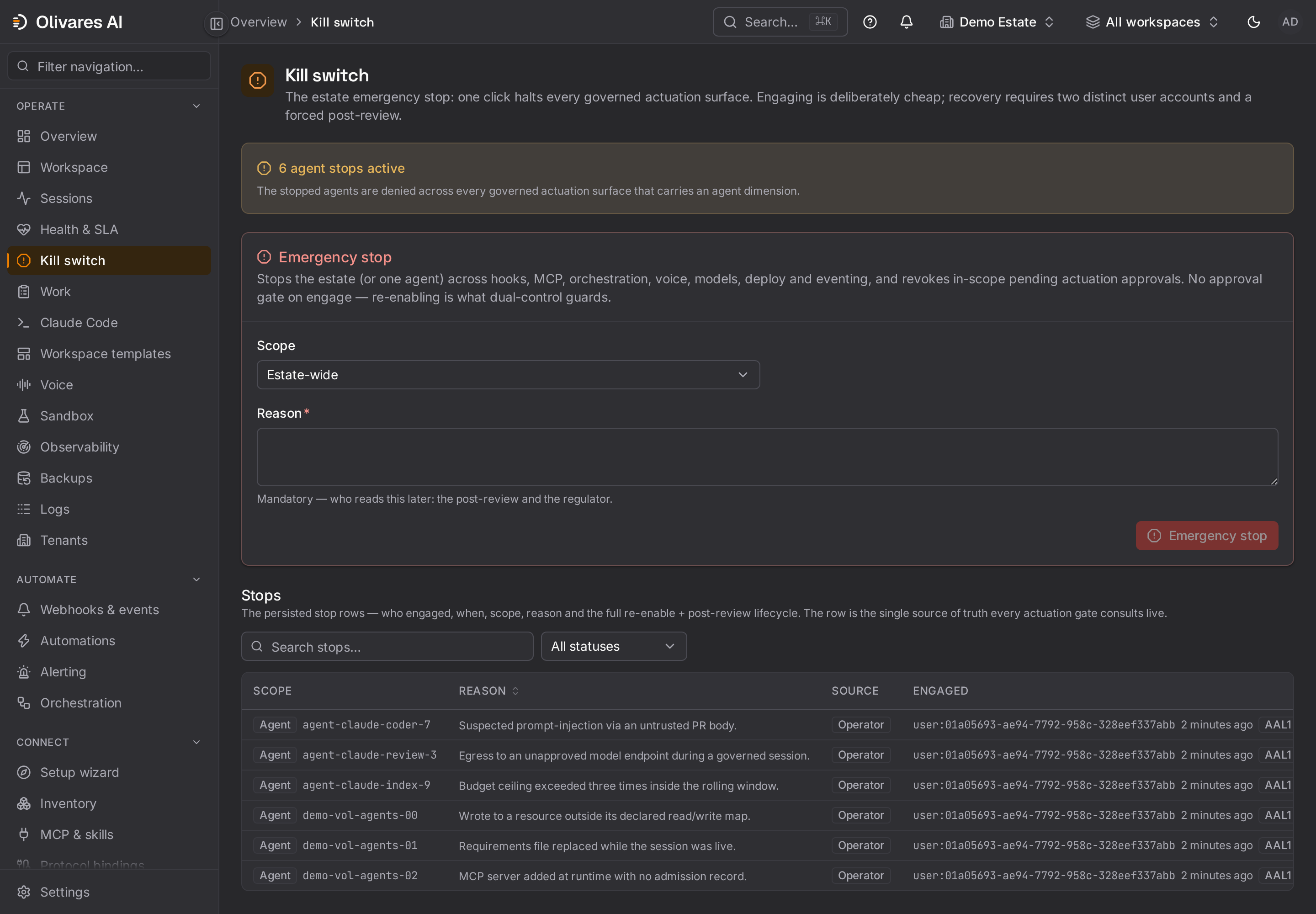
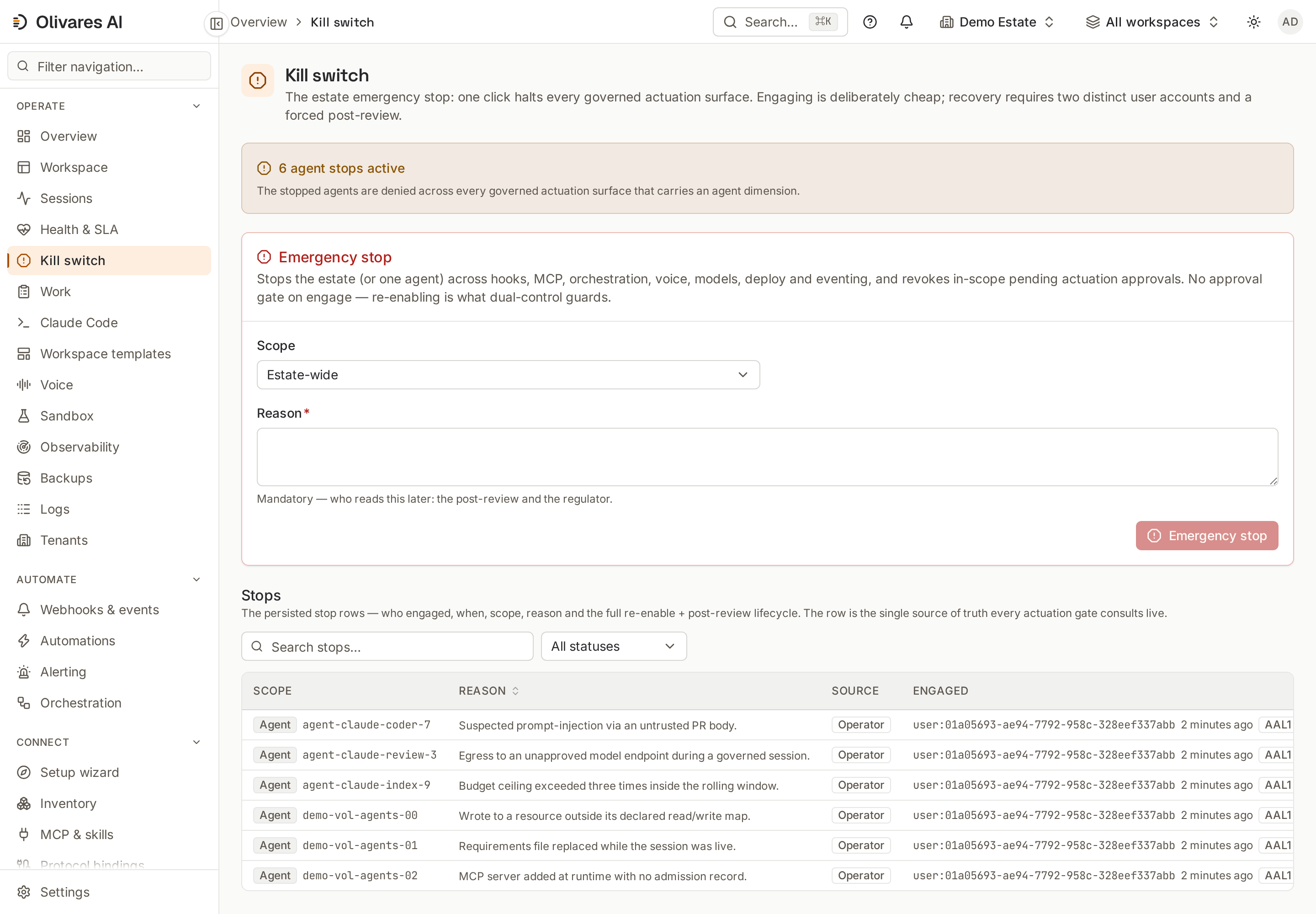
Drill it
Section titled “Drill it”A kill switch you have never pulled is a hypothesis. Quarterly, in a maintenance window:
- Engage an agent-scoped stop on a low-stakes agent; verify its tool calls deny and the finding fires.
- Walk the re-enable: two approvers, post-review, evidence pack pulled and archived.
- Time the loop end to end — that number is your real containment latency, and the drill leaves a complete ledger trail to show for it.