

OpenTelemetry GenAI (any instrumented agent)
Claude Code is the canonical cooperative source, but it is not the only
cooperative agent you run. The same connector that receives Claude Code’s
telemetry (kind: claude) carries an opt-in, vendor-neutral OpenTelemetry
GenAI profile: point any OTel-instrumented agent or framework at the same
OTLP receiver, and its gen_ai.* telemetry feeds the access-map and cost
pipeline — LangChain, LangGraph, CrewAI, AutoGen, Google ADK and anything
else that emits the GenAI semantic conventions on spans or log events.
Why it is opt-in
Section titled “Why it is opt-in”The OpenTelemetry GenAI conventions are Development status (pre-stable) upstream, and three dialects genuinely coexist in 2026 fleets. So the profile is off by default and gated exactly like the OTel SDKs gate it — by the opt-in token:
{ "sources": [{ "name": "agents-otel", "kind": "claude", "tenant": "<tenant-id>", "config": { "semconv_opt_in": "gen_ai_latest_experimental" } }]}semconv_opt_in mirrors OTEL_SEMCONV_STABILITY_OPT_IN: a comma-separated
list that must contain gen_ai_latest_experimental. With the profile off,
a gen_ai.* record still feeds the session-liveness watchdog but is not
mapped — honest absence, not silent ingestion.
What the normalizer accepts
Section titled “What the normalizer accepts”The profile is pinned to semconv v1.41.1 and normalizes the three GenAI dialects that coexist in real estates, stamping every normalized event with the dialect’s semconv pin so provenance survives:
| Dialect | Shape |
|---|---|
| Legacy OpenLLMetry | indexed gen_ai.prompt.{i}.* attributes |
| v1.36 and prior | the deprecated per-message events |
| v1.37+ | the messages generation |
On top of the message shapes it maps the mcp.* conventions (v1.39) and
the invoke_agent client/internal split plus invoke_workflow (v1.41) —
so framework-orchestrated agent and workflow invocations land as structured
topology, not noise. Span-based emission (how LangGraph, LangChain, CrewAI,
AutoGen and Google ADK instrument) and log-based emission are both ingested.
Cost samples are de-duplicated by W3C span id, so an agent whose telemetry arrives on both the span and log paths is never double-billed.
Wiring an agent to it
Section titled “Wiring an agent to it”The receiver is the connector’s own OTLP endpoint (gRPC 127.0.0.1:4317,
HTTP 127.0.0.1:4318 by default). On the agent side, standard OTel SDK
configuration applies — exporter endpoint to the loopback receiver, and the
GenAI opt-in if your instrumentation gates on it:
OTEL_EXPORTER_OTLP_ENDPOINT=http://127.0.0.1:4318OTEL_SEMCONV_STABILITY_OPT_IN=gen_ai_latest_experimentalWhat you’ll see in the console
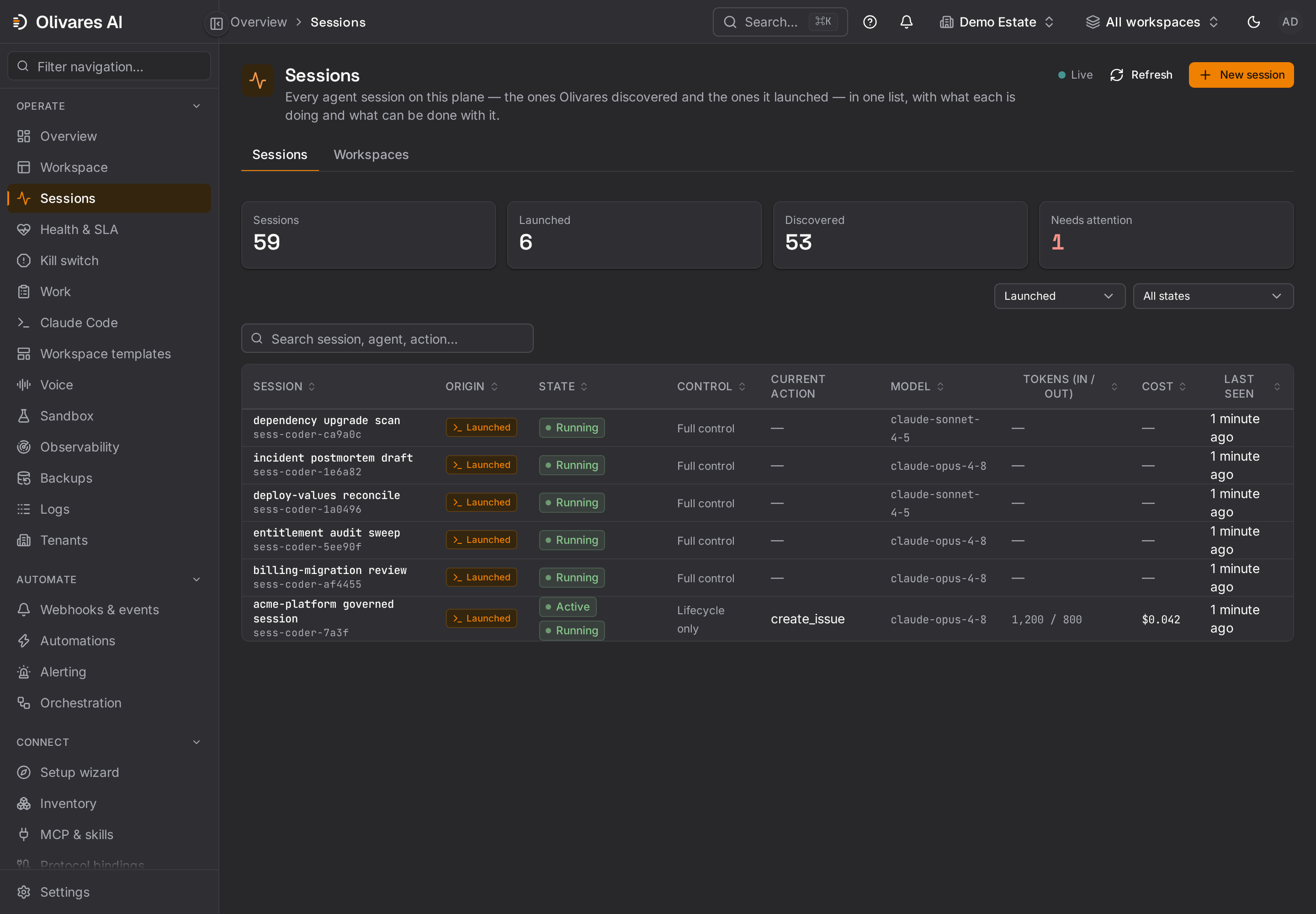
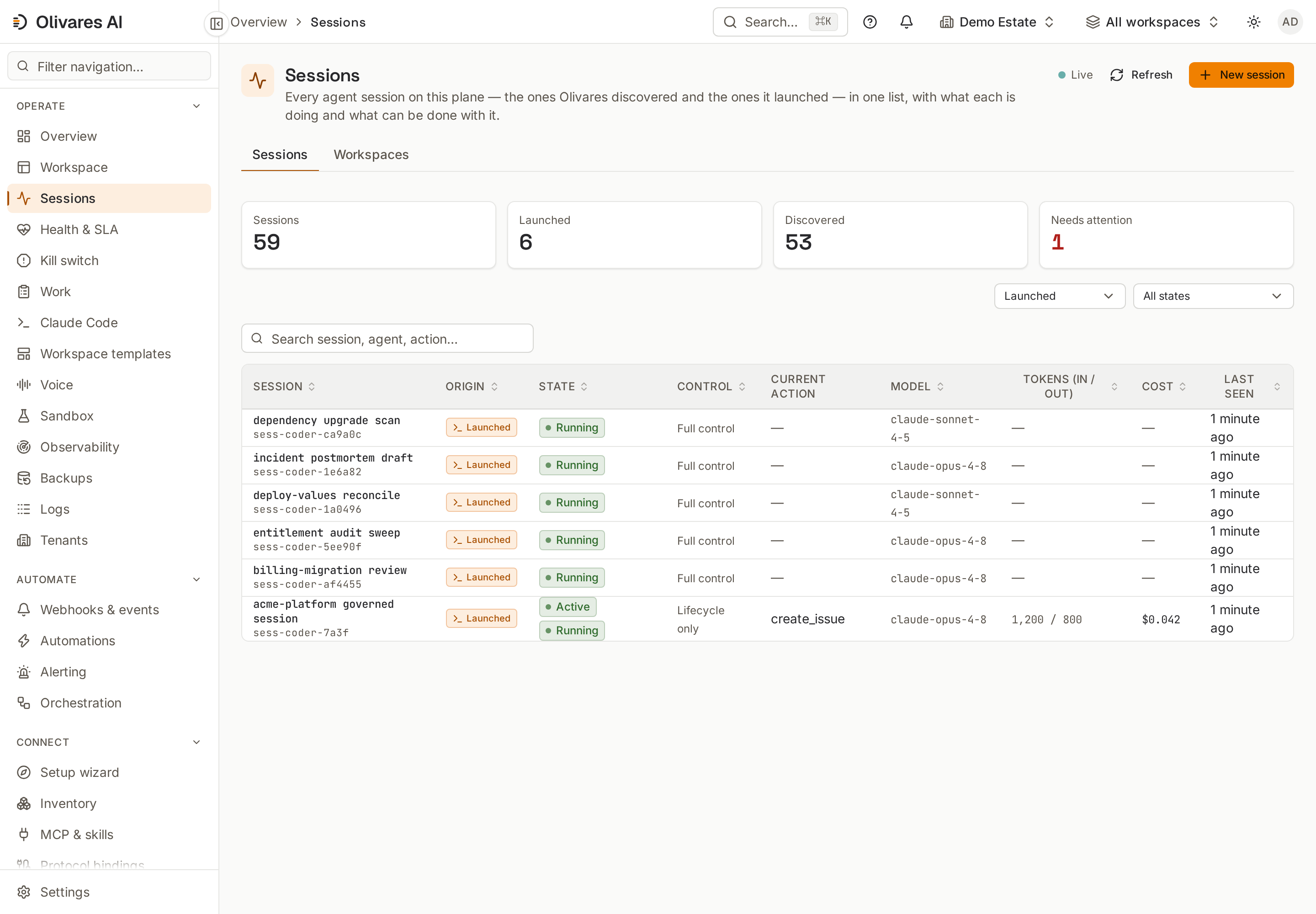
Section titled “What you’ll see in the console”Instrumented sessions appear in Sessions as live activity, attributed to the emitting agent; their model calls feed Cost & FinOps; MCP and tool spans contribute edges to the Access map like any cooperative source:
Honest limits
Section titled “Honest limits”- Pre-stable conventions, pinned ingest. The profile is pinned to v1.41.1; when upstream moves, the pin moves by a deliberate update, not by silent drift. Instrumentation that emits a fourth dialect is not guessed at.
- Cooperative means cooperative. An agent that does not emit is invisible to this path — that is what eBPF/Tetragon and store-native audit are for.
- Framework span-kind quirks are real. Some frameworks emit spans whose kind does not match the v1.41 client/internal rules; the normalizer maps what it can prove and leaves the rest unmapped rather than misattributed.
Related
Section titled “Related”- Connect Claude Code — the same receiver, Claude-specific surface.
- Enterprise OTel for Claude Code — fleet-wide telemetry posture.
- Events reference — the normalized observations this produces.