

Claude Code hooks & enforcement (the PEP)
Connect Claude Code wires the observation
half — OTLP telemetry in, access edges out. This page is the governance
half: Claude Code’s hooks report tool decisions to the connector, and an
opt-in policy enforcement point (PEP) turns that channel into a gate — the
connector answers a matching PreToolUse / PermissionRequest hook with a
permissionDecision of deny or ask, and records every gate as a finding.
The default is deliberately read-first: with no enforcement policy configured, hooks are observed, never gated. Enforcement is a named, explicit opt-in, and an invalid policy fails at startup — the connector will not run silently ungoverned.
How the hook channel works
Section titled “How the hook channel works”The connector’s OTLP/HTTP receiver (loopback 127.0.0.1:4318 by default)
also serves the hook endpoint at hook_path (default /hooks). On the
developer machine, Claude Code’s hook configuration posts its hook events to
that loopback endpoint — the exact hook settings syntax belongs to Claude
Code’s own documentation; what this product owns is the receiver and the
policy below.
Hook events and OTLP telemetry about the same tool call are correlated
(the correlation_window, default 5s, holds one side waiting for the other),
so a gated action and its telemetry land as one coherent story, not two
disconnected records. A session that keeps hooking but goes OTLP-silent
beyond silence_threshold (default 2m) is flagged as a telemetry gap — the
anti-evasion signal.
Turning on enforcement
Section titled “Turning on enforcement”Add an enforcement policy to the source’s config
(OLIVARES_SOURCES_CONFIG):
{ "sources": [{ "name": "claude", "kind": "claude", "tenant": "<tenant-id>", "config": { "enforcement": "{\"rules\":[{\"tool\":\"Bash\",\"decision\":\"ask\",\"reason\":\"shell needs a human\"},{\"resource_kind\":\"file\",\"mode\":\"write\",\"decision\":\"deny\"}]}" } }]}Rules match on the tool name and/or the resource kind and access mode; the
decision is deny or ask (escalate to the human in the session). Matching
PreToolUse / PermissionRequest hooks get that decision back as Claude
Code’s permissionDecision; everything else passes through observed. Each
gate is recorded as a finding, so the enforcement trail is queryable, not
folklore.
Fleet posture: managed settings, observed
Section titled “Fleet posture: managed settings, observed”Enforcement at the hook is one layer. The fleet-wide layer is Claude Code’s
managed settings file, which the managed-settings source observes
read-only:
{ "sources": [{ "name": "fleet-policy", "kind": "managed-settings", "tenant": "<tenant-id>", "config": { "config_path": "/etc/claude-code/managed-settings.json", "expected_policy": "{…governance-authored intent…}" } }]}| Key | Default | Meaning |
|---|---|---|
config_path | /etc/claude-code/managed-settings.json (Linux) | the host’s live managed-settings file (macOS: /Library/Application Support/ClaudeCode/…) |
scope | OS hostname | attribution scope (host id / distribution name) |
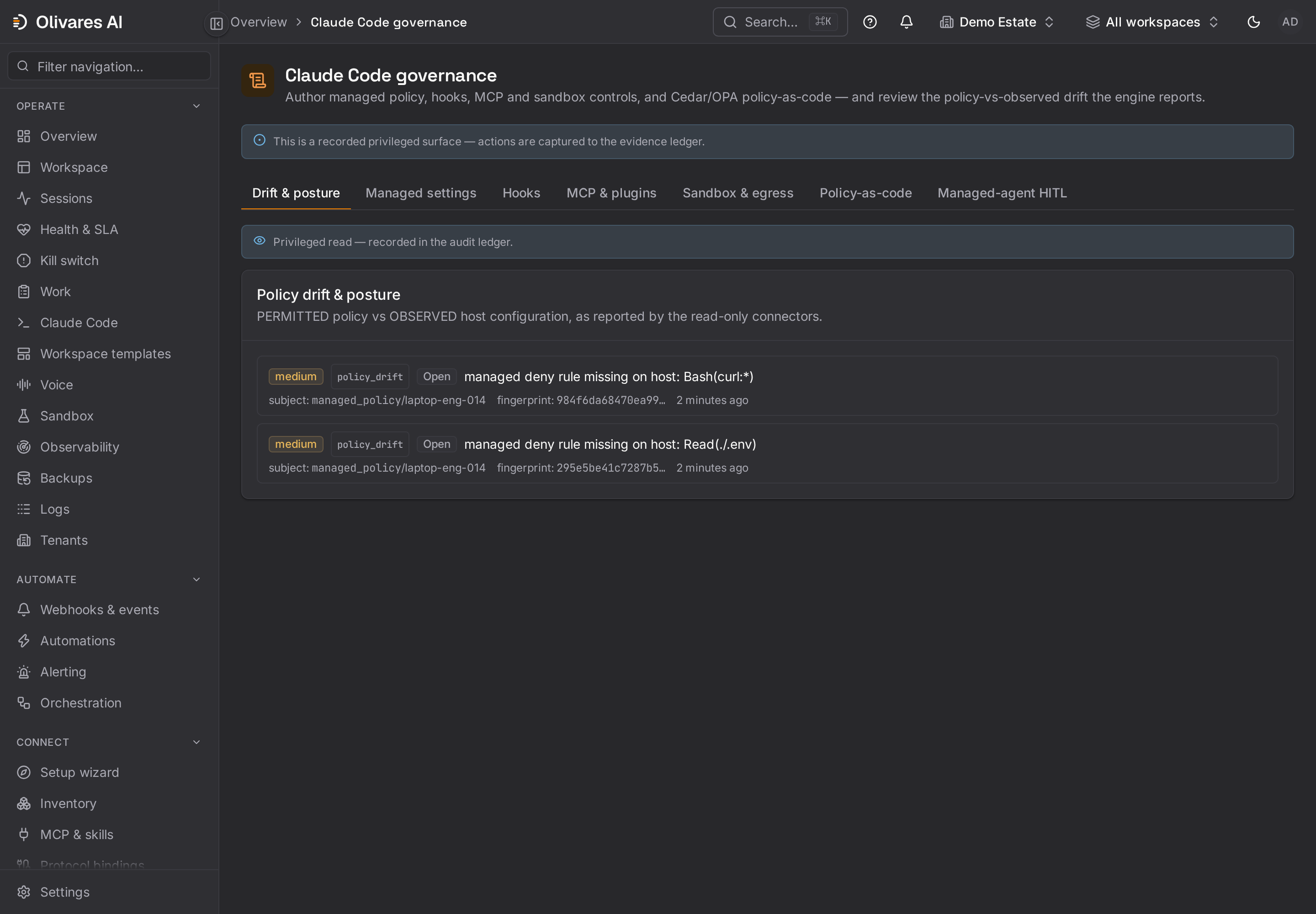
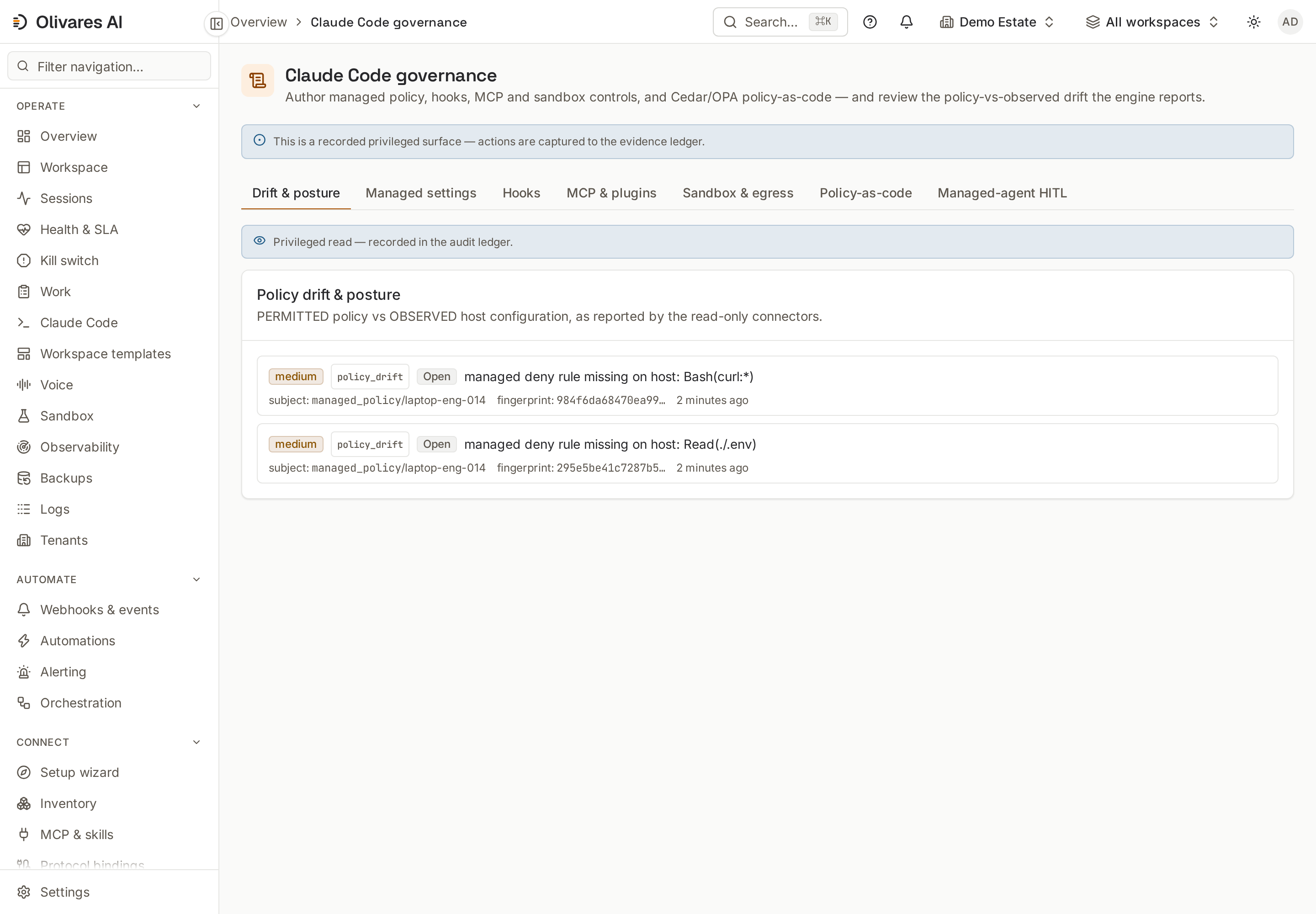
expected_policy | — | optional authored intent; when set, the connector reports drift (permitted-policy vs observed-config). Empty = observe-only |
Related opt-in observers on the claude source: managed_mcp_path (models
the managed-MCP allowlist’s eval order and flags name-only allow entries) and
sandbox_path (posture findings on the sandbox lockdown settings) — both
read-only, both off until pointed at a file.
What you’ll see in the console
Section titled “What you’ll see in the console”Claude Code governance is the authoring and truth-loop surface: the policy you intend, the configuration hosts actually carry, and the drift between them. Gates and telemetry-gap findings land in Security; the session itself stays visible in Sessions:
Honest limits
Section titled “Honest limits”- The PEP gates what hooks report. A host whose hooks are not configured is not gated — pair the fleet with the managed-settings observer so absence is visible, and with the kernel backstop so it is not blind.
askdefers to a human in the session — it is friction, not a lock.denyis the lock.- Subprocesses are out of scope here (hooks fire for Claude Code’s own tool calls); see the enterprise OTel page for what the telemetry env does and does not reach.
Related
Section titled “Related”- Connect Claude Code — the observation half.
- Enterprise OTel for Claude Code — fleet telemetry, labels, tracing.
- Govern and approve — the authorization model the PEP plugs into.