

Integrate Grok Build
The grok integration governs Grok Build, the terminal agent, from the host where it runs. In
read-only mode, it reads the TOML configuration, sandbox profile, MCP server names, system
requirements, and the file that disables hooks. It can also receive OTLP traces. This is not the
xAI API connector: it does not query remote models and does not require a provider secret.
Preventive tool control uses olivares grok-hook and a separate local PEP.
Add Grok Build
Section titled “Add Grok Build”Prerequisites
Section titled “Prerequisites”- Olivares AI and Grok Build installed on the same host, or the Grok configuration paths mounted read-only on the connector host.
- The UUID of the tenant to which the posture will be attributed.
- Permission for the Olivares service account to read
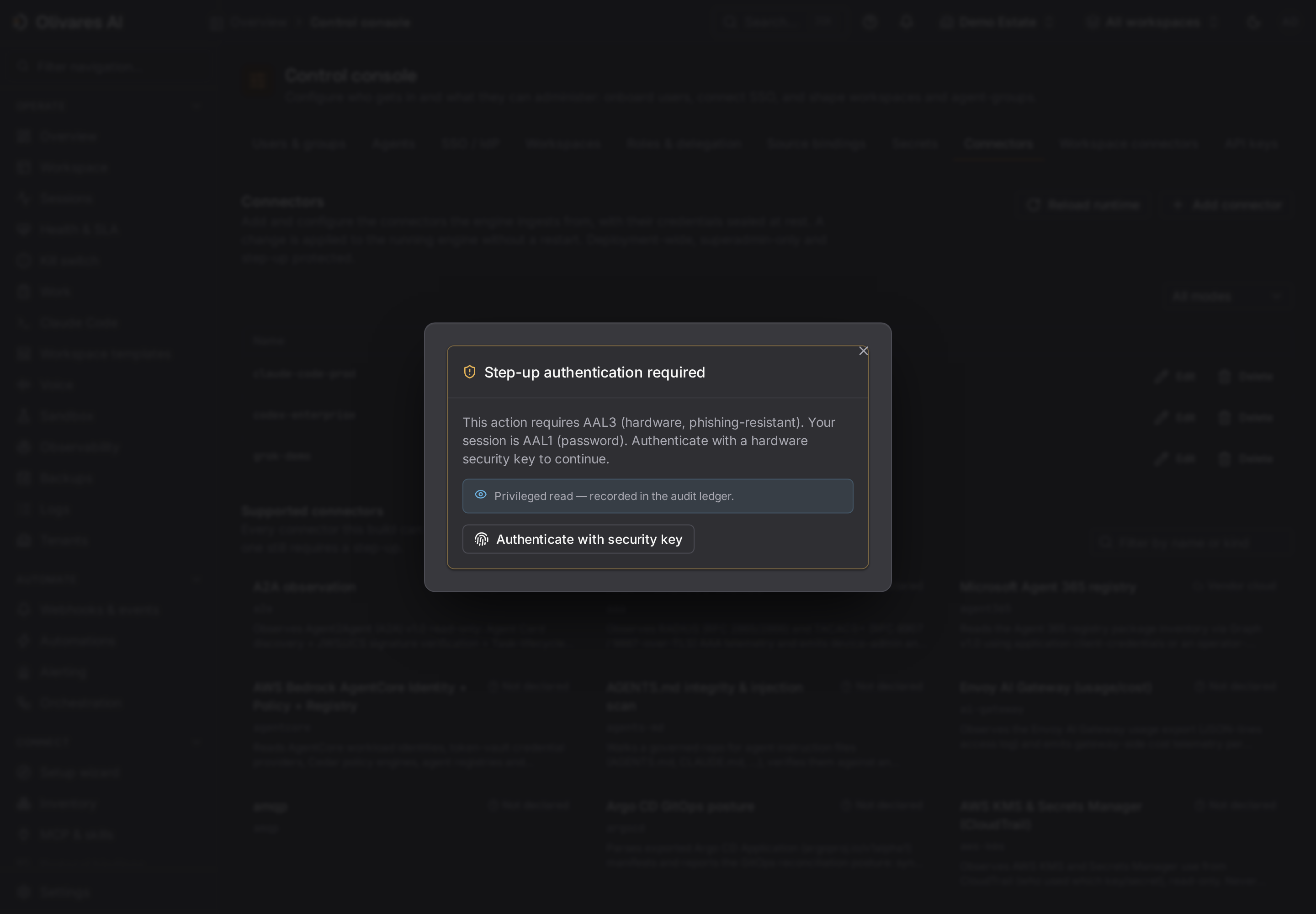
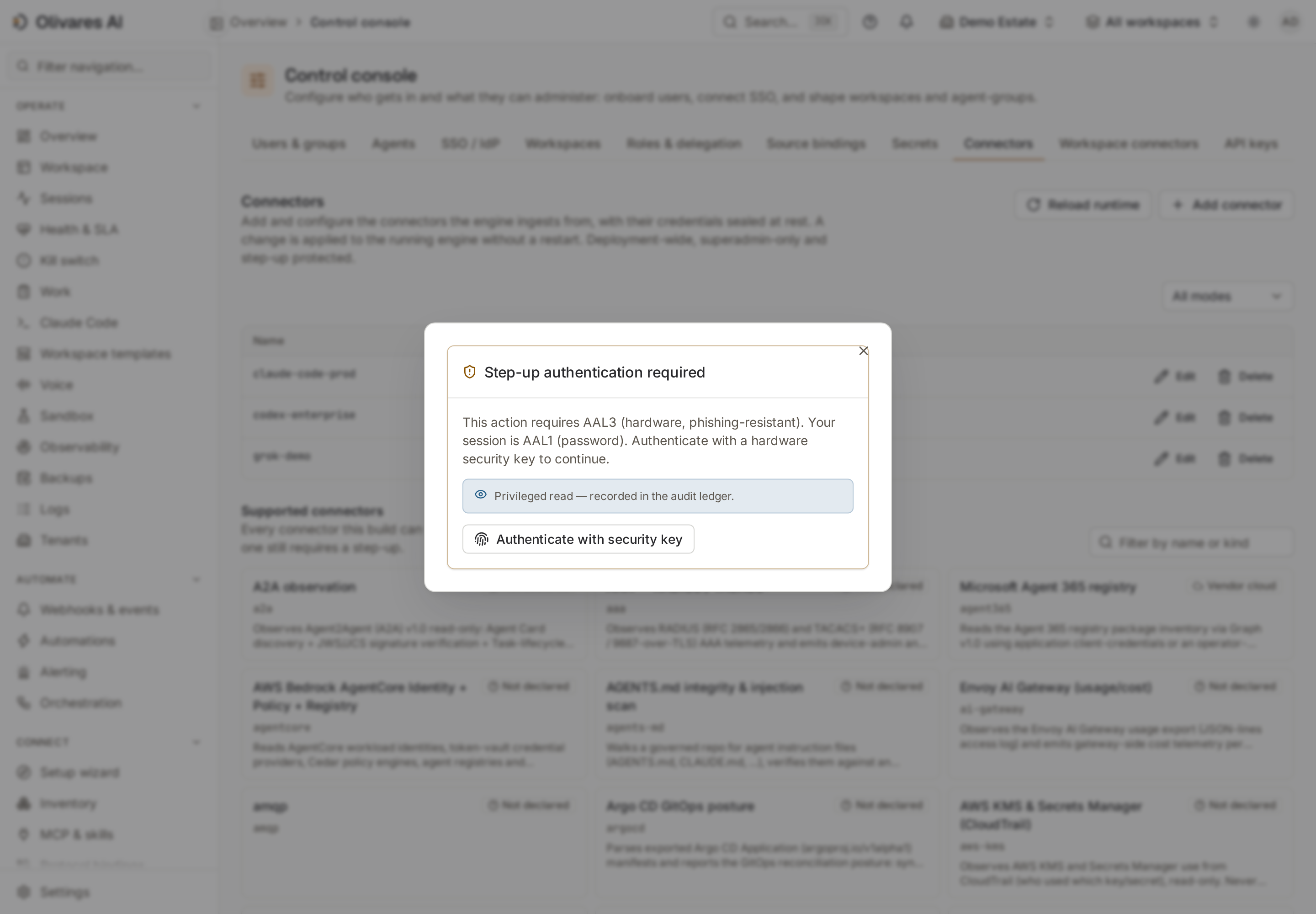
~/.grok/config.toml,/etc/grok/requirements.toml,~/.grok/disabled-hooks, and, when configured, the compatiblemanaged-settings.json. - A superadmin account with AAL3 elevation if the source is created from the console.
Do not enter an xAI key for this source. It has no secret field and makes no inference API calls.
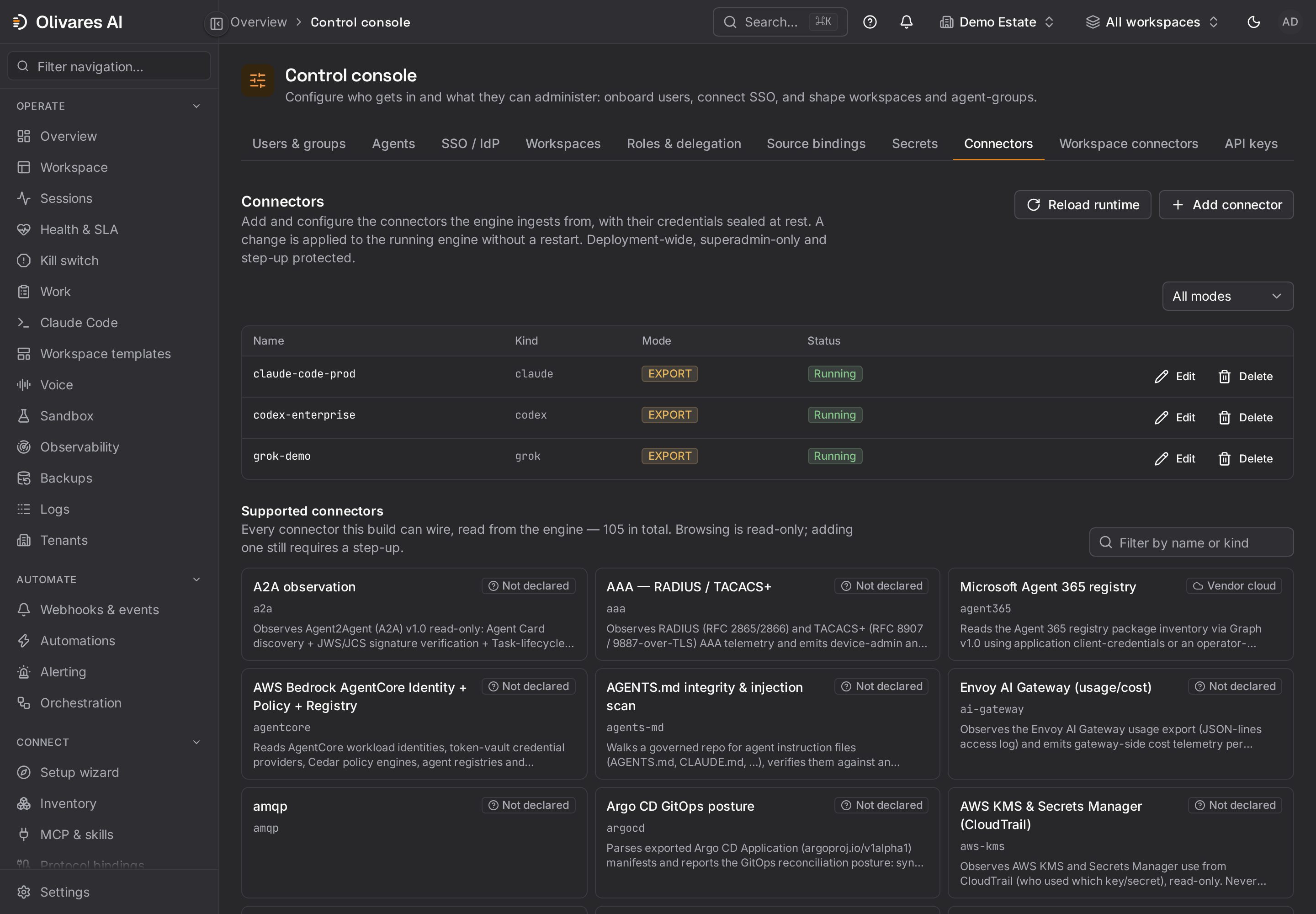
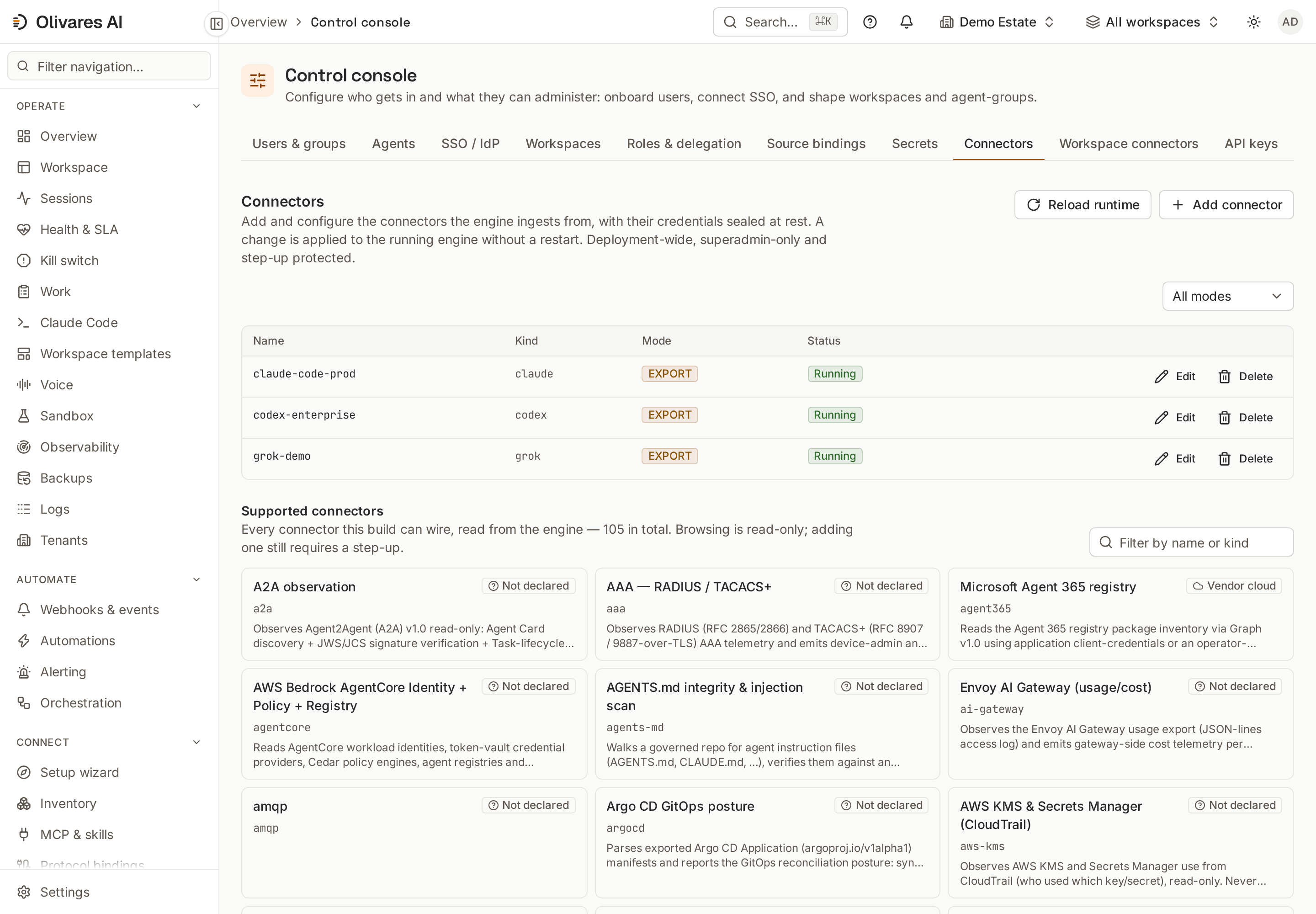
- Open Control console (
/console) and select the Connectors tab. - Add a source of type
grokwith the namegrok-demo—or a stable host name—the tenant, a batch interval, and enabled status.60seconds provides visible posture changes during a pilot without turning local file reads into a continuous loop. - Save the source, select Test, and reload the roster. The row confirms the roster entry; the
first subsequent
Gatheris what reads the files and emits findings.
Configure Grok Build
Section titled “Configure Grok Build”1. Host inventory and requirements
Section titled “1. Host inventory and requirements”| Source setting | Default | What it measures |
|---|---|---|
agent_ref | grok-build | Stable reference included in findings. |
config_path | ~/.grok/config.toml | User-declared sandbox profile and MCP server names. |
requirements_path | /etc/grok/requirements.toml | System layer that constrains the effective configuration. |
disabled_hooks_path | ~/.grok/disabled-hooks | User-disabled hook names, one per line. |
managed_settings_path | empty | Claude Code-compatible managed-settings.json honored by Grok; empty means “not measured.” |
otlp_http | false | Trace receiver, disabled until the operator reserves a port. |
On Linux, the minimum requirement for enforcing the sandbox is:
[sandbox]profile = "strict"Distribute this in /etc/grok/requirements.toml with administrative ownership. strict limits
writes to the workspace, ~/.grok/, and temporary directories, and blocks network access under
the documented Linux guarantee. The same value in ~/.grok/config.toml is only a user preference:
command-line options and the environment can affect the configuration, whereas
requirements.toml is the constraining layer.
To restrict MCP, declare in requirements.toml only the
[mcp_servers.<nombre-aprobado>] tables that the fleet may use. Olivares inventories the names,
not the commands, URLs, or credentials in those tables. A missing file, an unreadable file, and a
present file without [mcp_servers] produce different states; “not measured” is never displayed
as “none.”
Grok can also read /etc/claude-code/managed-settings.json for compatibility. Set
managed_settings_path only when Olivares should measure that surface. Do not reuse a Claude hook
without verification: Grok payloads use camelCase keys and snake_case event names, and require
olivares grok-hook.
2. Governed hook
Section titled “2. Governed hook”Install olivares grok-hook through the native discovery mechanism of the deployed Grok version:
either a settings JSON file from which Grok consumes the hooks key, or a *.json file in a hook
directory such as ~/.grok/hooks/. Grok loads these files by name. Olivares does not define the
complete authoring wrapper, and this tree does not retain it; use the schema for the installed
version and set the command exactly to:
olivares grok-hookThe PEP is mounted when OLIVARES_GROK_HOOK_PEP_CONFIG points to a valid configuration as
Olivares starts:
{ "listen": "127.0.0.1:8449", "tenant": "11111111-1111-4111-8111-111111111111"}Each instance governs one tenant and requires firm identity. The client reads
OLIVARES_GROK_HOOK_URL, OLIVARES_GROK_HOOK_TOKEN, OLIVARES_GROK_HOOK_TENANT,
OLIVARES_GROK_HOOK_AGENT, OLIVARES_GROK_HOOK_ORG, and OLIVARES_GROK_HOOK_ACCOUNT. Supply
these values through the process and secrets manager; the token does not belong in the hook JSON.
The name assigned to the hook matters. A user can add it to ~/.grok/disabled-hooks, and the
dispatcher will omit it regardless of whether it came from a managed layer. Neither
requirements.toml nor MDM constrains that file. The connector reads it and emits a high-severity
finding with the disabled names, but it cannot prevent the disablement.
3. Optional OTLP traces
Section titled “3. Optional OTLP traces”When otlp_http=true, the receiver listens on 127.0.0.1:4318 by default and accepts
POST /v1/traces, the path measured for Grok Build. This unauthenticated input must remain on
loopback. If another connector already uses 4318, select an unused local port and apply the same
value to otlp_http_addr and the agent’s OTLP endpoint.
Collection reduces traces to attribution, span name, and session_id; it does not retain content.
In this version, the next poll emits an aggregate finding with span, session, and drop counts. Use
the hook for the timeline and per-tool control.
CLI usage
Section titled “CLI usage”The following examples were run with the worktree binary on August 30, 2026. General startup messages are omitted.
Register the local source
Section titled “Register the local source”olivares sources set \ --data-dir /var/lib/olivares \ --name grok-demo \ --kind grok \ --tenant 11111111-1111-4111-8111-111111111111 \ --poll-seconds 60 \ --actor platform-operator \ --reason integration-guide-rolloutcreated source "grok-demo" (kind "grok", tenant "11111111-1111-4111-8111-111111111111", enabled true) kind: - → grok tenant: - → 11111111-1111-4111-8111-111111111111 poll_seconds: - → 60 enabled: - → true→ reload a running engine to apply: POST /v1/console/runtime/reload, or `kill -HUP <pid>` (it also applies at next boot)With SQLite, stop the engine before an offline roster mutation or use the live console. With
PostgreSQL, the command can run alongside the engine. --actor and --reason attribute the
provenance change.
For non-default paths, add explicit configuration values:
olivares sources set \ --data-dir /var/lib/olivares \ --name grok-demo \ --config config_path=/srv/grok-home/.grok/config.toml \ --config requirements_path=/etc/grok/requirements.toml \ --config disabled_hooks_path=/srv/grok-home/.grok/disabled-hooks \ --config managed_settings_path=/etc/claude-code/managed-settings.json \ --actor platform-operator \ --reason grok-paths-for-service-userConnectivity test and actual file reading
Section titled “Connectivity test and actual file reading”The reproducible measurement taken on the screenshot host on August 30, 2026 produced this result:
olivares sources test \ --data-dir /var/lib/olivares \ --name grok-demo \ --timeout 20sconfiguration: VALID (everything that can be decided without the network)source "grok-demo" (grok): ANSWERED — the connector opened with this configuration and was closed againNO SOURCE ROW WAS WRITTEN and nothing was wired into a running engine.The process exited with code 0. That host had an active Grok session and a present
~/.grok/config.toml; /etc/grok/requirements.toml and ~/.grok/disabled-hooks were absent.
sources test read none of them: Open only resolves configuration, and test closes immediately
without calling Gather. Therefore, ANSWERED does not prove the session, sandbox, or findings.
To test file reading, reload the engine and inspect the findings emitted by the next poll.
Verify fail-closed hook client behavior
Section titled “Verify fail-closed hook client behavior”With the endpoint unconfigured:
printf '%s' '{"hookEventName":"pre_tool_use","sessionId":"s-1","toolName":"Bash"}' | olivares grok-hookStandard output:
{"decision":"deny","reason":"no governance endpoint is configured (deny-closed)"}Standard error:
no governance endpoint is configured (deny-closed)The exit code is 2, which Grok interprets as a veto for pre_tool_use. For other events, a
denial is recorded but cannot prevent the action; the client reports this on stderr instead of
claiming enforcement.
Control console
Section titled “Control console”| Location | What it shows | Operational limitation |
|---|---|---|
Control console > Connectors (/console) | grok roster, configured paths, interval, mode, and Test/Save/Reload actions. | The test opens and closes the connector; it does not read the TOML files. |
Health > Connectors (/health) | Source status, message, trend, and latest poll. | Process health does not prove that a missing file is governed. |
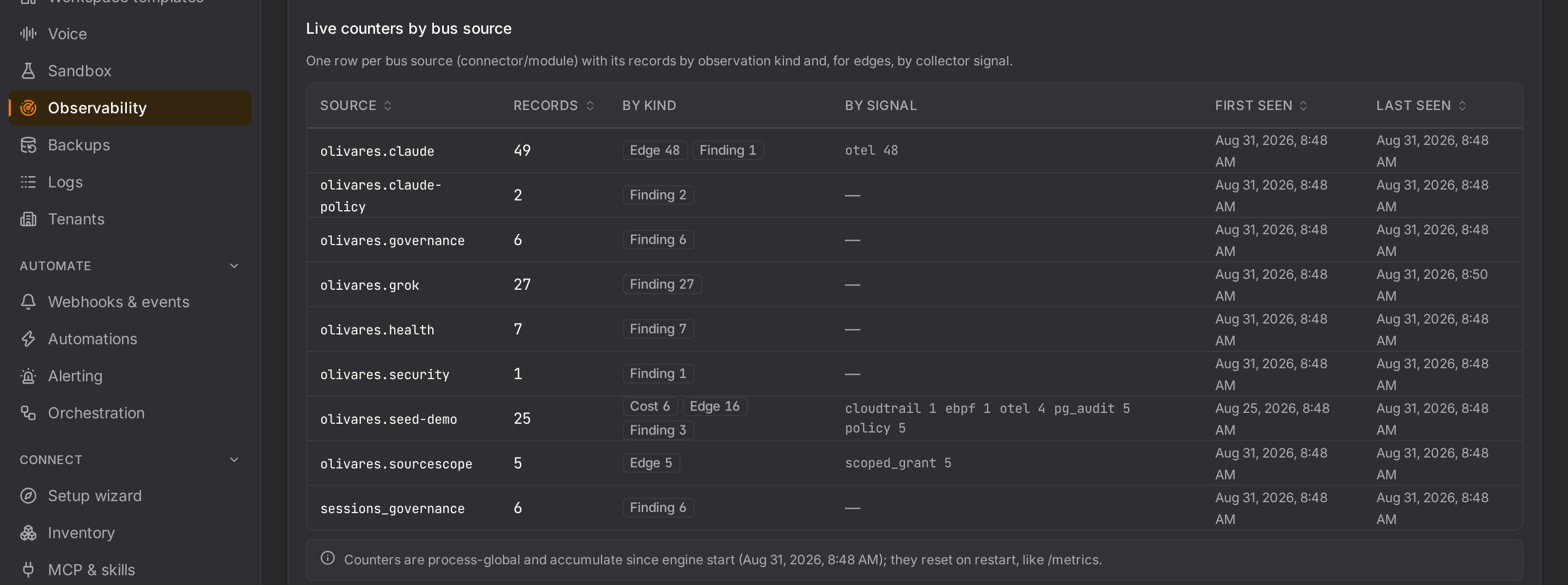
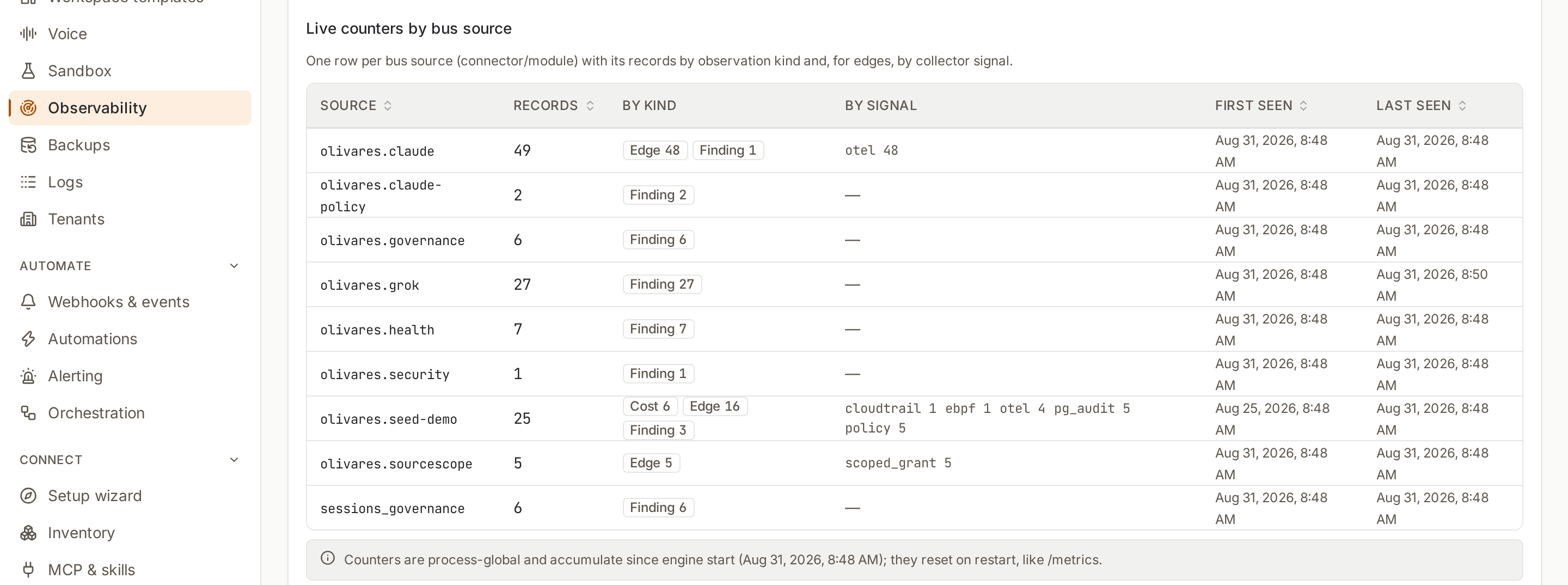
Observability > Ingestion (/observability) | Findings emitted by olivares.grok, first/last record, and, when enabled, aggregate OTLP activity. | Process-wide counters since startup; they reset and are not tenant-specific. |
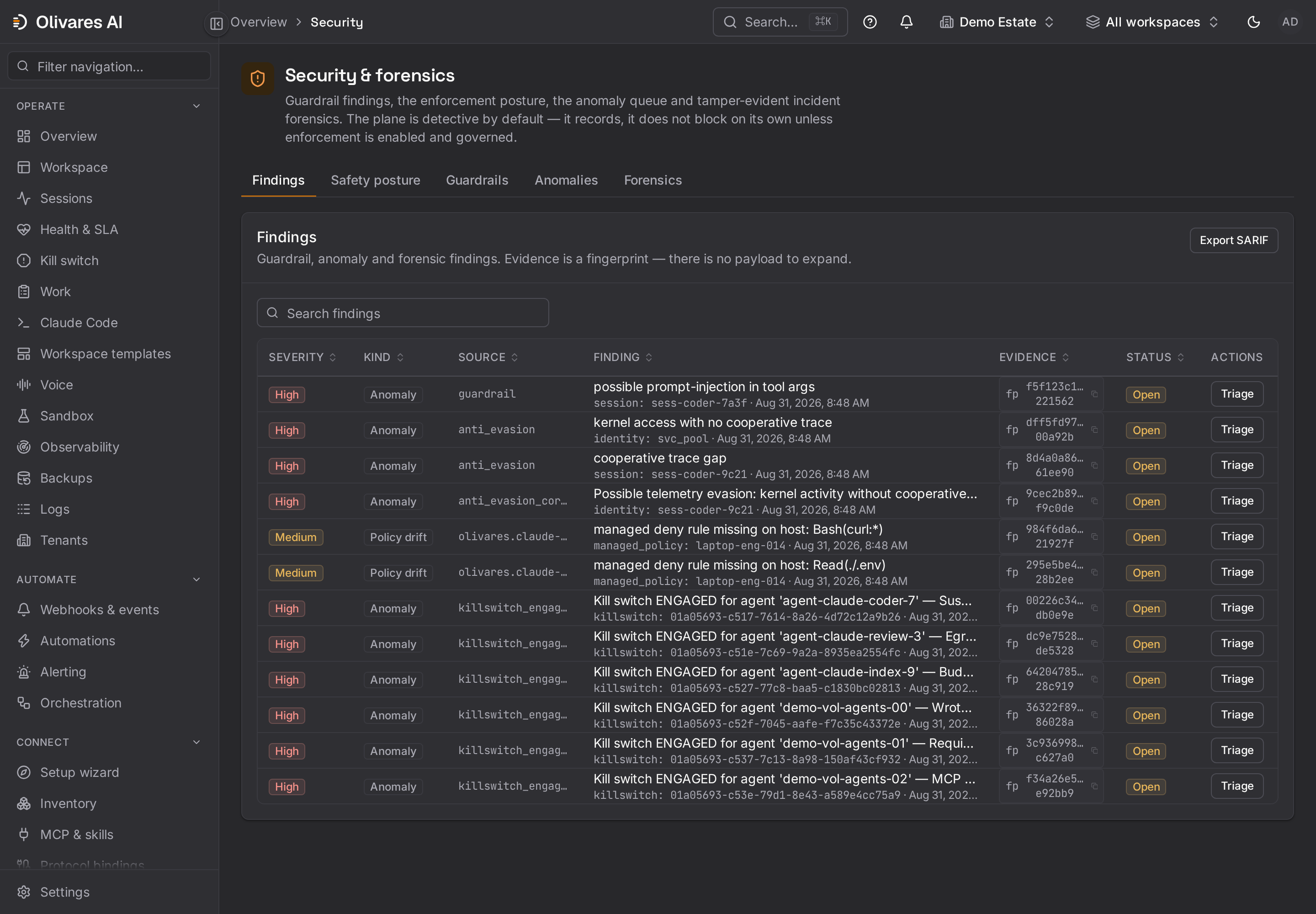
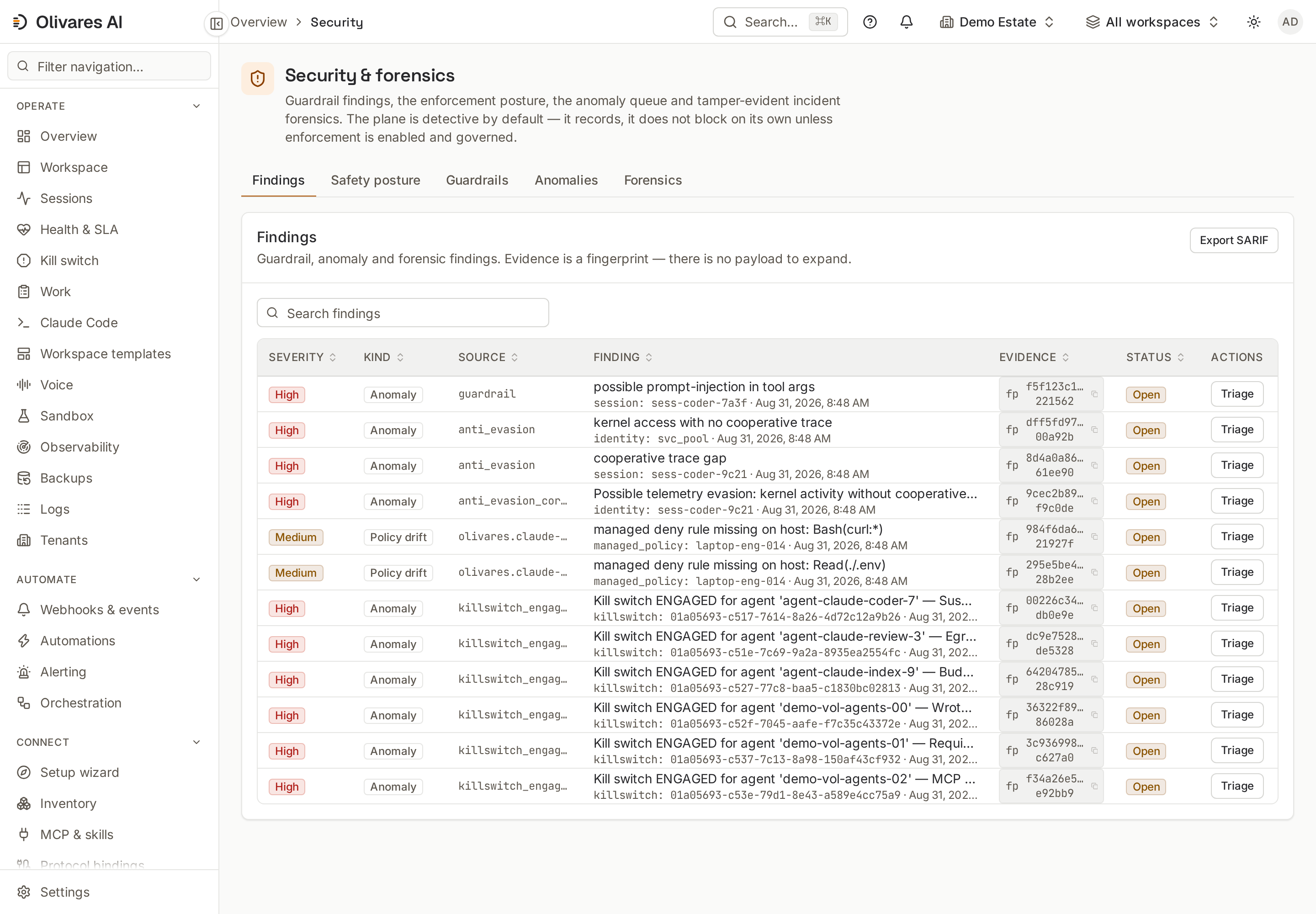
Security (/security) | Observed and enforced sandbox profile, MCP names, requirement presence/validity, managed-settings compatibility, and disabled hook names. | “Unreadable” remains unknown rather than becoming absent. |
Sessions (/sessions) | Session, action, identity, permission mode, latest activity, and enforced or observed posture. | Requires hook events. Local inventory does not create a session. |
Audit (/audit) | Attributable PEP decisions and chained evidence. | Exists only for calls that reached the PEP; a disabled hook leaves a gap. |
Do not expect a model catalog, xAI spend, or prompts: this source does not use the xAI API, and the OTLP receiver discards content.
Production use
Section titled “Production use”- Linux endpoint baselines: Distribute
requirements.tomlas a root-owned file and poll every host. Absence becomes an actionable finding, not a green default. - MCP control: Compare user-declared names with those fixed by the administrator. The
GROK_CONFIGvariable cannot add sensitive tables such as MCP, authentication, or egress; that protection comes from Grok, and Olivares reports it without duplicating it. - Hook canary: Start with a harmless tool and confirm the event, decision, and effect. Then
monitor
disabled-hookscontinuously because the control can disappear by name. - Shared endpoints: Configure absolute paths to the actual
HOMEof the account that runs Grok. The Olivares service’s~can resolve to another user and produce an accurate measurement of the wrong host profile. - Minimal telemetry: Enable OTLP only when the aggregate signal is required, and reserve a dedicated local socket. For preventive governance, prioritize reliable hook execution.
What is enforced and what is only observed
Section titled “What is enforced and what is only observed”| Surface | Actual behavior |
|---|---|
grok source | Observed, read-only. Reads files and emits findings; does not modify Grok Build or call xAI. |
/etc/grok/requirements.toml | Enforces in the agent the constrained sandbox and MCP values. Olivares verifies its presence and declared effect. |
~/.grok/config.toml | Observed preference. Not an administrative policy by itself. |
olivares grok-hook on pre_tool_use | Can prevent the tool when the command runs and exits with 2. The client denies closed when the PEP is missing or fails. |
| Other Grok events | Observed. The denial remains as evidence, but the event has no equivalent veto. |
| Timeout, crash, or a hook that never runs | Agent fails open. Grok continues; the internal fail-closed behavior of olivares grok-hook applies only when the process is invoked. |
~/.grok/disabled-hooks | Can disable even a managed hook. Olivares detects this afterward, but no requirements layer prevents it. |
| OTLP receiver | Observes aggregates. Does not authenticate, retain content, or replace the hook timeline. |
A deployment must not be declared “enforced” merely because the sandbox is fixed. Completion
requires effective requirements, a hook that actually runs, continuous monitoring for its absence
from disabled-hooks, a visible event, and a demonstrated pre_tool_use veto.