

eBPF / Tetragon (the kernel backstop)
The ebpf source is the anti-evasion half of the R/RW map. Where the
cooperative path sees what an agent reports, this sees what the kernel
did — file reads/writes and outbound connections — even when an agent
disables its own telemetry, because it runs outside the agent’s control.
Two design decisions define it, and both are the security posture:
- It does not load eBPF programs itself. Tetragon
does the kernel capture, deployed as a separate hardened service holding
CAP_BPF+CAP_PERFMON. The connector is a zero-capability, read-only consumer of Tetragon’s JSON event export (a shared file/FIFO, mode0600, or stdin). - It is blind to TLS bodies and payloads. It observes access relationships — never content.
The repository ships the reference deployment under connectors/ebpf/deploy/:
a hardened Tetragon DaemonSet, the two TracingPolicies (file access, network),
and a Compose variant for single hosts.
What it emits
Section titled “What it emits”| Field | Value |
|---|---|
| Signal source | ebpf |
| Mode | file read / write, network connect edges |
| Origin | a runtime identity (process/container) — kind identity, never a resolved agent |
| Confidence | always approximate — see below |
| Coverage tier | kernel backstop |
The approximate is precise, not modest: the access is kernel ground truth
(the syscall happened); what the kernel cannot give is the agent — it knows
the process and cgroup, not which governed agent that was. The access-map
module upgrades attribution when an identity source binds the runtime
identity to an agent.
1. Deploy Tetragon (the sensor)
Section titled “1. Deploy Tetragon (the sensor)”On Kubernetes, apply the shipped DaemonSet and TracingPolicies:
kubectl apply -f connectors/ebpf/deploy/tetragon-daemonset.yamlkubectl apply -f connectors/ebpf/deploy/tracingpolicy-file-access.yamlkubectl apply -f connectors/ebpf/deploy/tracingpolicy-network.yamlTetragon writes its JSON export to the shared volume
(/var/run/olivares/tetragon.log); the connector reads it from the other
side. On a single host, connectors/ebpf/deploy/docker-compose.yaml is the
same split without Kubernetes. The full architecture and hardening notes are
in connectors/ebpf/deploy/README.md.
2. Declare the source
Section titled “2. Declare the source”{ "sources": [{ "name": "node-kernel-backstop", "kind": "ebpf", "tenant": "<tenant-id>", "config": { "events_path": "/var/run/olivares/tetragon.log", "detect_evasion": "true" } }]}| Key | Default | Meaning |
|---|---|---|
events_path | - (stdin) | Tetragon JSON event stream — file, FIFO, or stdin |
follow | true | keep reading as the stream grows |
detect_evasion | false | opt-in: flag a known agent process whose cooperative telemetry goes silent while the kernel still sees it acting |
evasion_window | 5m | grace period before a missing cooperative connection is flagged |
agent_signatures | claude,claude-code | executable names classified as cooperative agents for the detector |
otlp_endpoints | 127.0.0.1:4317,127.0.0.1:4318 | the cooperative-telemetry endpoints whose connections the detector correlates |
The connector consumes Tetragon ProcessKprobe events (file operations and
network connects) and ProcessExit (detector state); ProcessExec is used
for attribution context and never emitted as an edge.
3. What you’ll see in the console
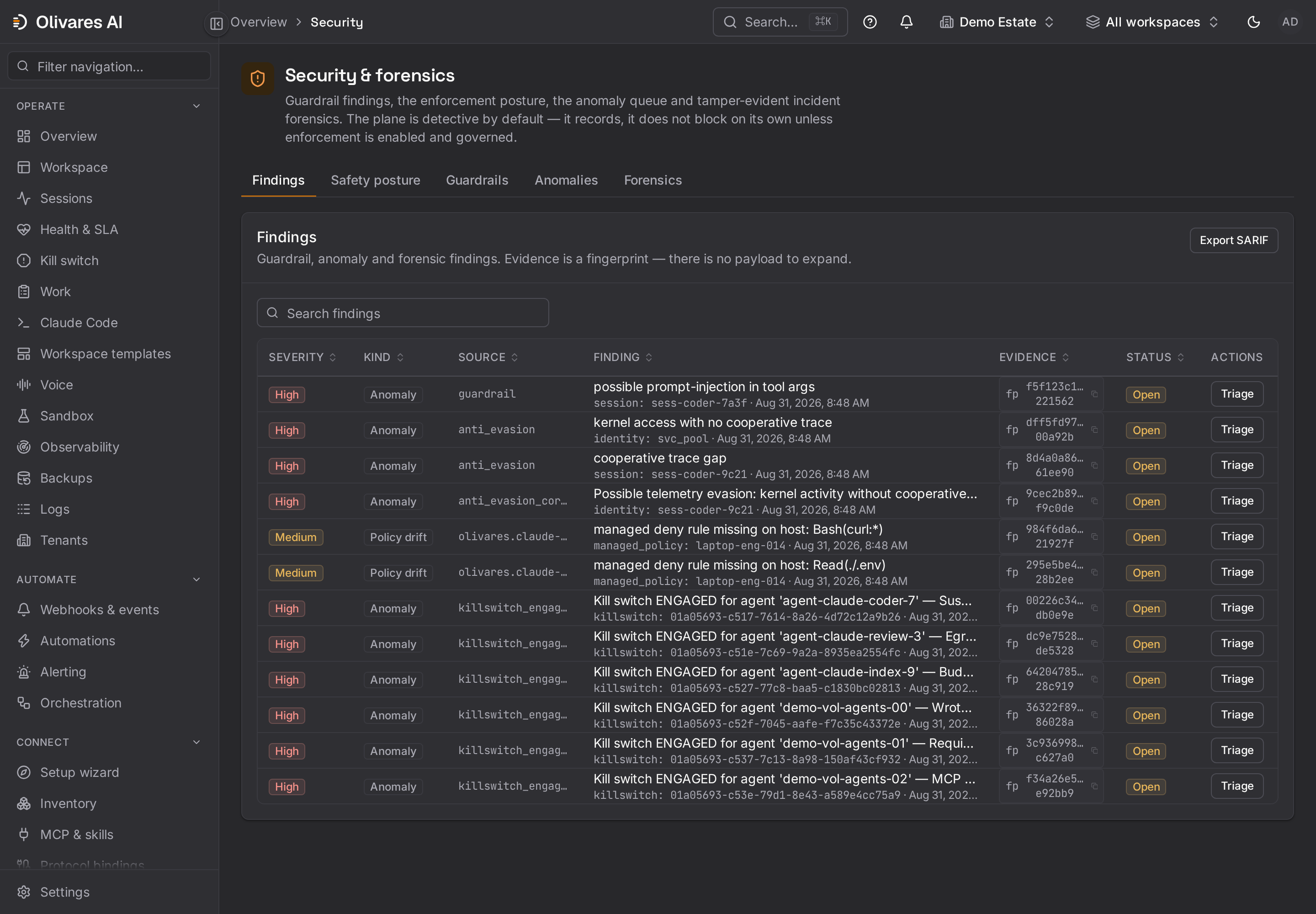
Section titled “3. What you’ll see in the console”Kernel edges join the access map attributed to runtime identities, always
marked approximate. The detector’s output lands in Security as
findings — a session that stops emitting while the kernel still sees activity
is exactly the case this source exists for:
Honest limits
Section titled “Honest limits”- Its end-to-end attribution depth is still being proven out. The cooperative path and store-native audit are the verified, high-fidelity signals; treat the kernel backstop as a floor-raiser, not a finished primary source (Honesty & limits).
- Tetragon’s scope is its TracingPolicies. The shipped policies cover file access and network connects; what they do not trace does not exist in the export.
- Process ≠ agent. Without an identity binding, every kernel edge stays
approximate— by design, not by accident.
Related
Section titled “Related”- Connect Claude Code — the cooperative half this backstops.
- SSO/SCIM & identity sources — how attribution gets upgraded.
- Security hardening — where the backstop fits in the defensive posture.