

MCP introspection & registry governance
The mcp source governs the capability surface your agents see: it
introspects MCP servers (tools, resources, prompts), derives read/write
hints from their annotations, and — opt-in — reconciles what is running
against the public MCP Registry, your federated registries, and the Docker
MCP Catalog, grading posture along the way.
One rule anchors everything this source emits:
Declare the source
Section titled “Declare the source”{ "sources": [{ "name": "mcp-estate", "kind": "mcp", "tenant": "<tenant-id>", "config": { "config_path": "/etc/claude-code/.mcp.json", "posture_scan": "true", "registry_enabled": "true" } }]}Point it at servers either way:
| Key | Meaning |
|---|---|
servers | inline JSON array of MCP server specs to introspect |
config_path | path to a Claude Code .mcp.json whose mcpServers are introspected |
timeout | per-server introspection timeout |
The governance layers (each opt-in, each honest)
Section titled “The governance layers (each opt-in, each honest)”- Posture scan (
posture_scan, defaulttrue) — scans the introspected catalog metadata for tool-poisoning, injection, homoglyphs and over-broad scopes, grading posture against the OWASP MCP Top-10. Catalog metadata only — it does not probe or exploit servers. - Public registry (
registry_enabled, defaultfalse;registry_url) — read-only provenance enrichment from the MCP Registry (preview upstream; the connector self-verifies what it reads). - Registry sync (
registry_sync+owned_namespaces) — enumerate the reverse-DNS namespaces your org owns in the public registry to detect yanked or unmanaged publications (the supply-chain angle), and clear your internal servers from shadow flagging. - Internal reconciliation (
internal_servers) — a JSON array of approved internal servers ({name, registry_name, version}); running servers are reconciled against it, with version-drift detection. What runs but is not on the list is a shadow finding. - Federated registries (
federated_registries) — GitHub BYO org registries, Azure API Center and private subregistries implementing the pinned/v0.1registry OpenAPI. - Deprecation feed (
deprecation_feed) — fetch the official MCP deprecated-features registry each pass to detect rule drift; the compiled deprecation rules never depend on the fetch. - Docker MCP Catalog (
docker_catalog) — image digest-pin drift plus Docker-built (signed) vs community (unattested) provenance per server. - Next-revision preview (
next_revision_preview) — introspect servers in the MCP 2026-07-28 RC stateless mode while still advertising 2025-11-25; explicitly a preview knob.
Findings land per layer: posture grades, provenance gaps, shadow servers, deprecated-feature usage, registry drift.
What you’ll see in the console
Section titled “What you’ll see in the console”MCP & skills is the live capability catalog — servers, their tools and declared hints, skills, and how each is wired into agents:
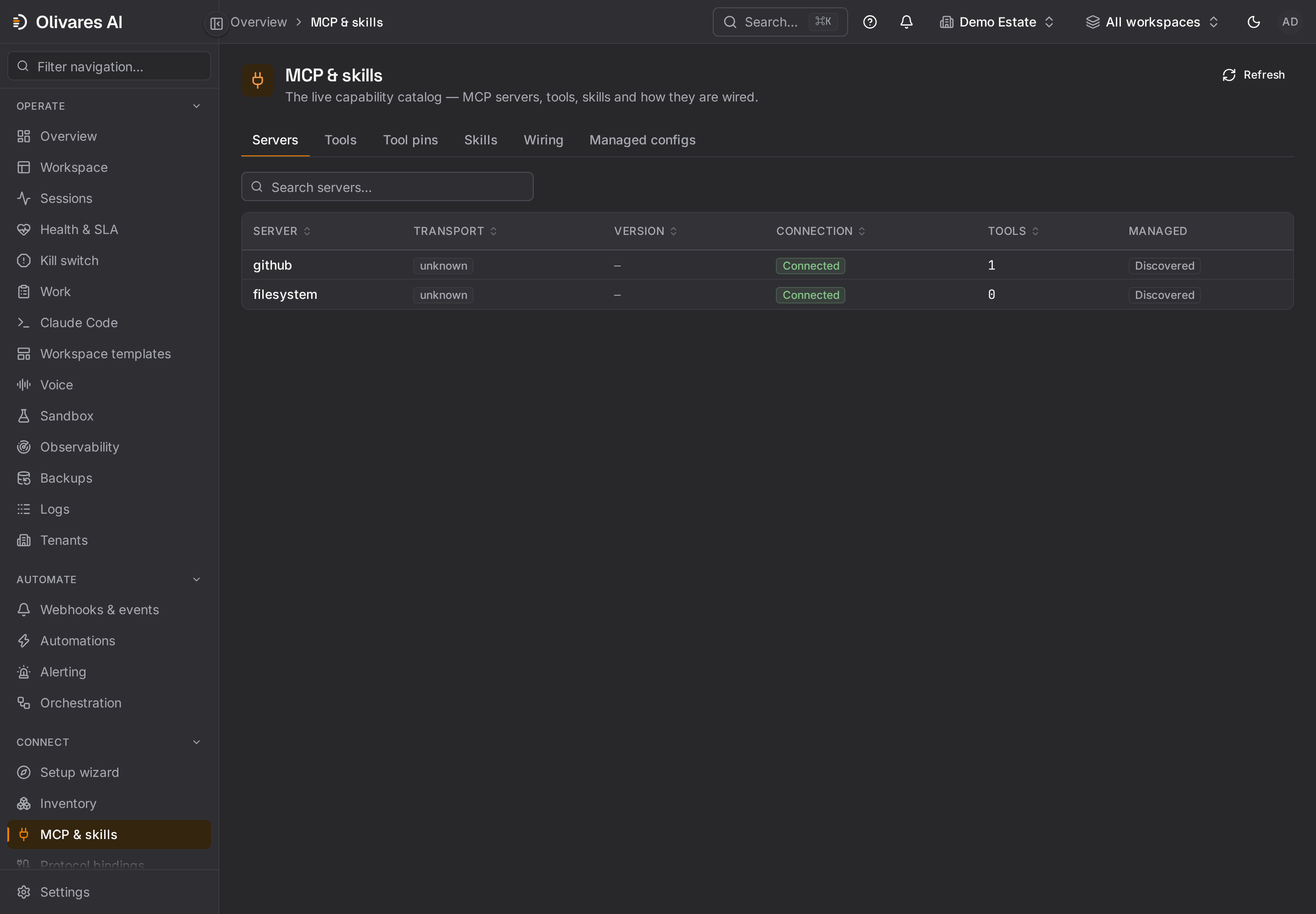
The hints contribute the declared surface to the Access map; the drift panel is where a declared-read-only tool observed writing stops being a hint problem and becomes a finding.
Honest limits
Section titled “Honest limits”- Introspection is a snapshot of what servers claim. A server can lie; that is the spec’s own position and the reason every edge is marked the way it is. Corroboration comes from observed sources.
- A partial registry snapshot is an error, not a result — the connector refuses to grade against a registry read it could not complete.
- The posture scan reads metadata. It does not execute tools, fuzz servers, or detect a backdoored implementation behind a clean catalog.
Related
Section titled “Related”- Connect Claude Code — where MCP hints meet session telemetry.
- Module V — MCP, skills & capabilities.
- Build and ship a connector — the deny-closed signed admission story for connector binaries themselves.