

Integrate Claude Code
This integration brings Claude Code under the governance control plane without making Olivares AI
a mandatory proxy. The claude connector receives OTLP telemetry and hook events, correlates
sessions, and records R/RW access, costs, and findings. When preventive control is required, the
managed olivares claude-hook hook queries the local Olivares PEP before each tool use. These two
planes are independent: receiving telemetry does not mean that policy is being enforced.
Add Claude Code
Section titled “Add Claude Code”Prerequisites
Section titled “Prerequisites”- An Olivares AI binary that includes the first-party
claudeconnector. - The UUID of the enterprise tenant to which observations will be attributed.
- Claude Code installed on the endpoints to be governed. The local receiver does not require an Anthropic API key.
- Local connectivity from Claude Code to the Olivares receiver. The defaults are
127.0.0.1:4317for OTLP/gRPC and127.0.0.1:4318for OTLP/HTTP and cooperative hooks. - An executable temporary path for the Olivares service.
clauderuns as an isolated plugin; on systems where/tmpis mounted withnoexec, setTMPDIRin the service unit to a dedicated directory owned by the Olivares service account.
Do not expose the OTLP receivers or cooperative endpoint beyond loopback. They do not authenticate the sender, so any host that can reach them could fabricate telemetry. The governed PEP is a separate surface: it uses its own local socket, authenticates every request, and records each decision.
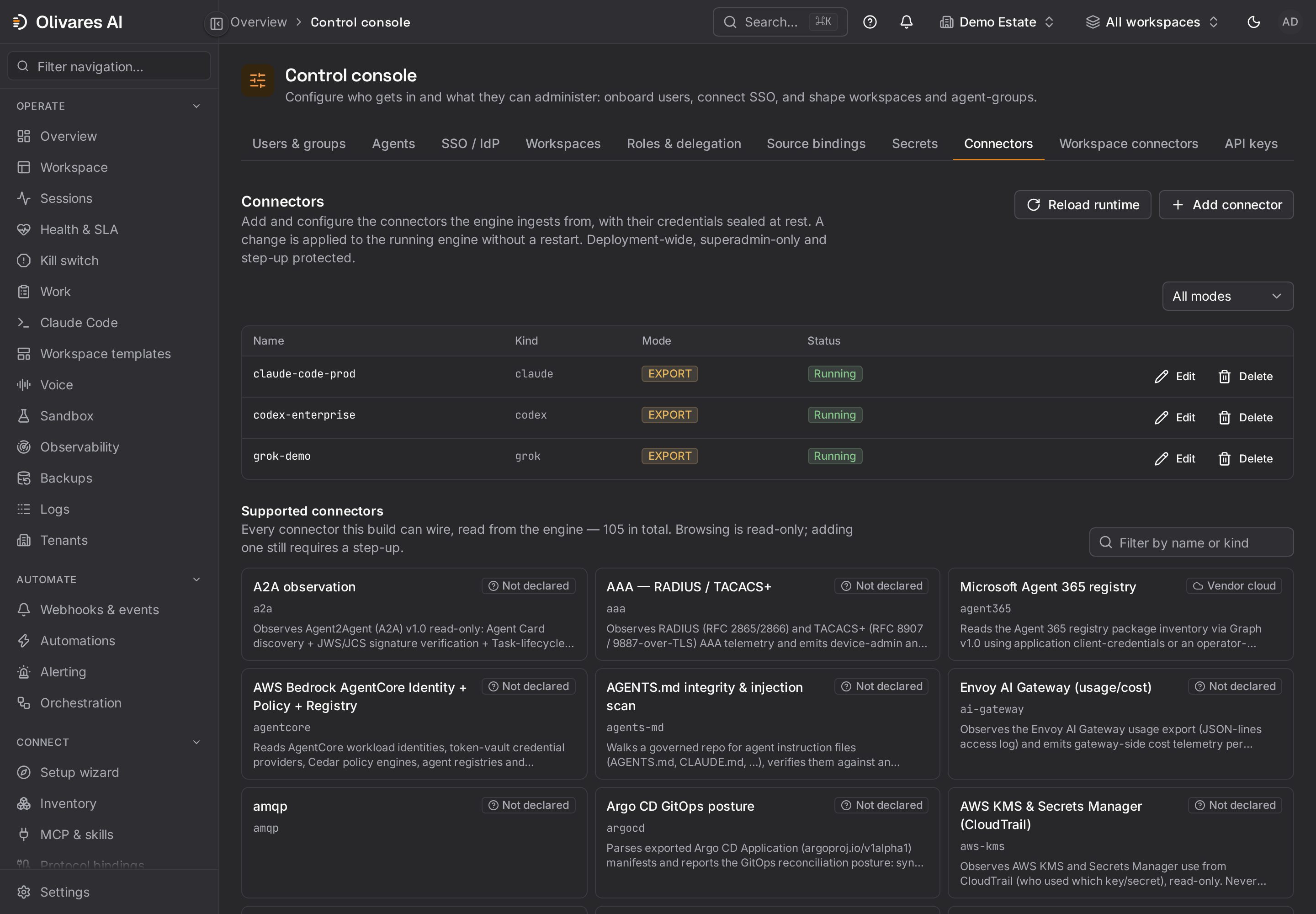
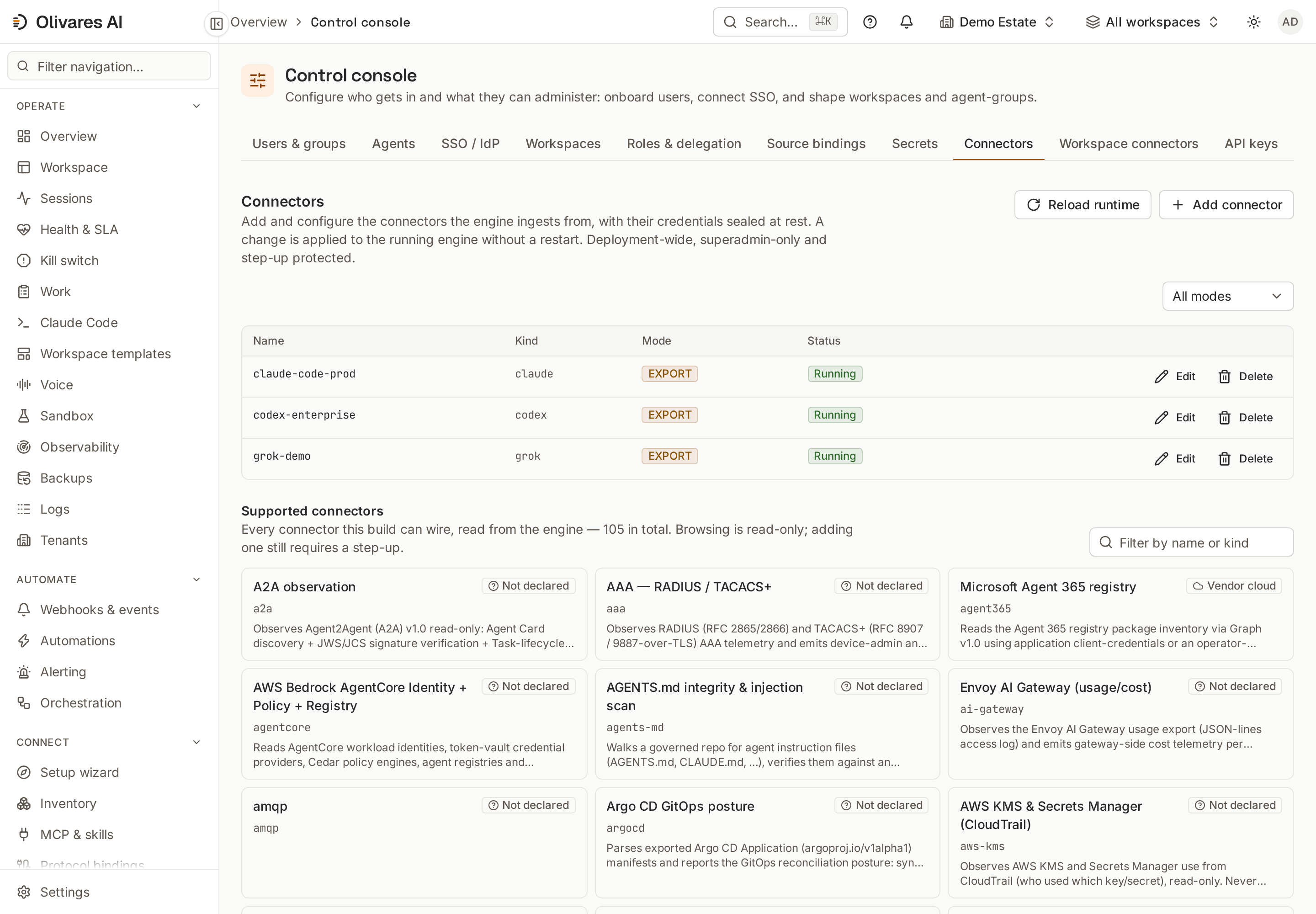
- Open Control console (
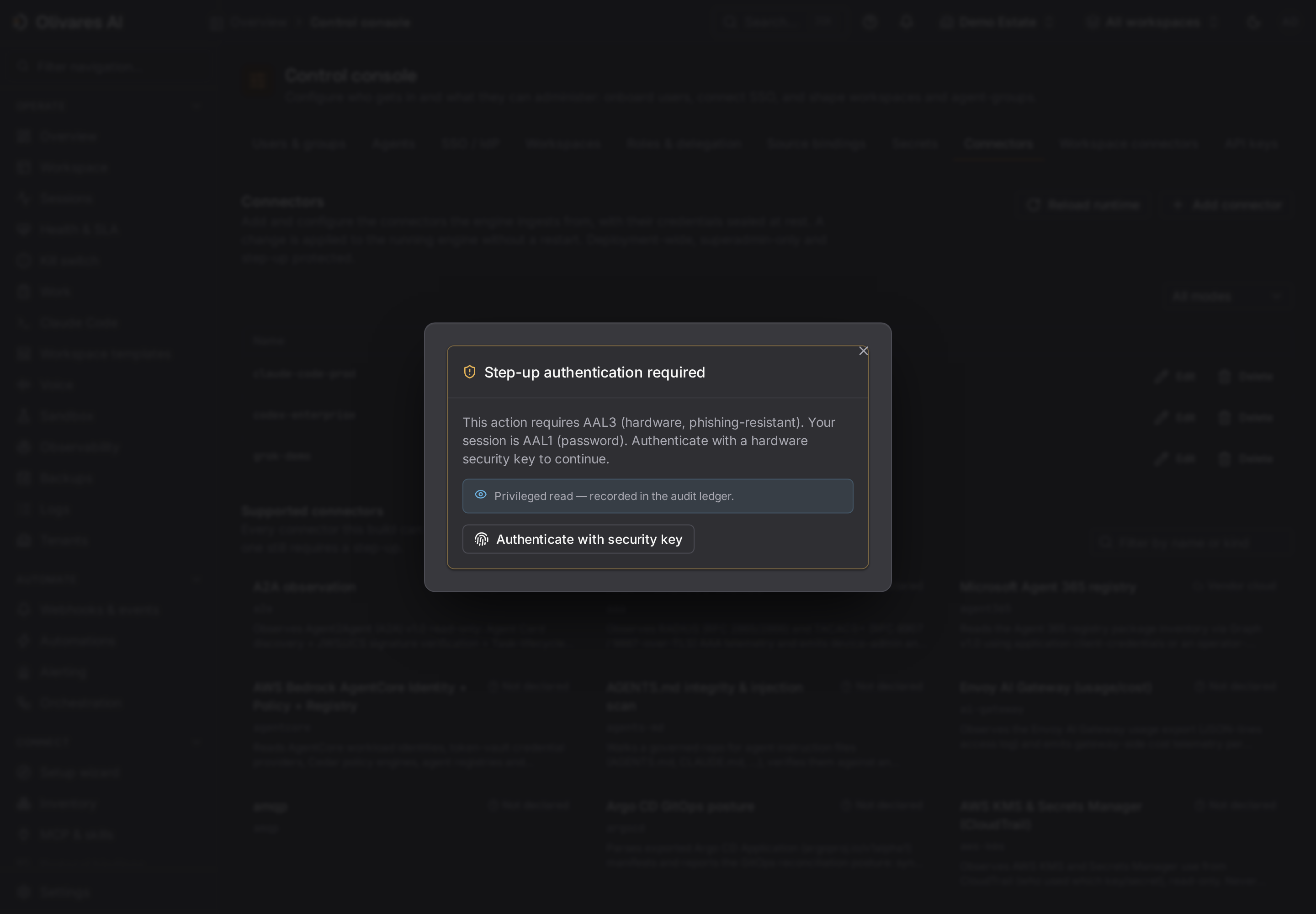
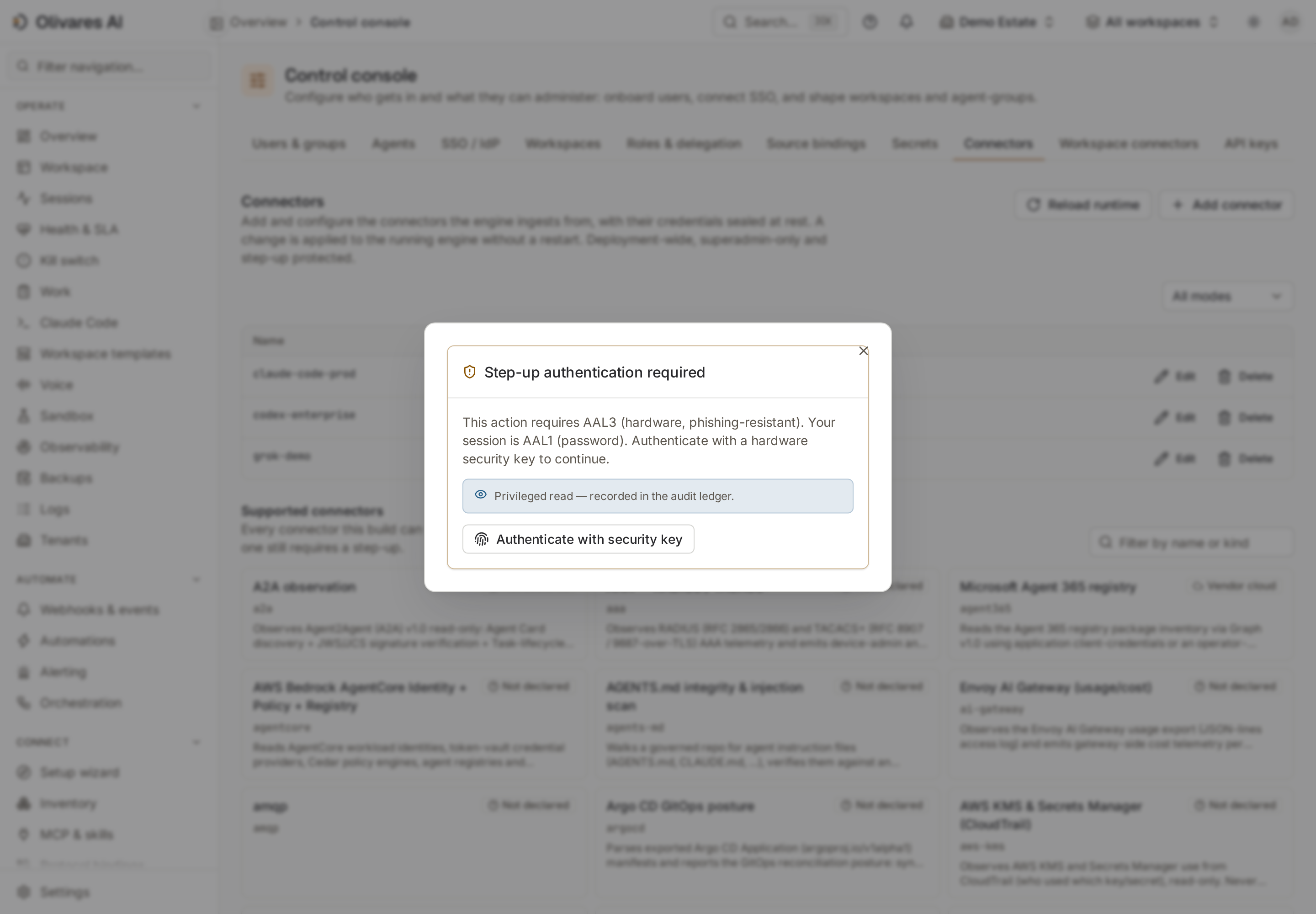
/console) and select the Connectors tab. The connector roster is global: a superadmin account is required, and saving, testing, and reloading require AAL3 elevation. - Add a source with type
claude, a stable operational name such asclaude-code-prod, the appropriate tenant,livemode, interval0, and enabled status. A zero interval is correct: this connector maintains receivers rather than polling in batches. - Save the source and select Reload. The row confirms its name, type, mode, and status. The
console test action is unavailable for
claudebecause it is an out-of-process connector; validation occurs on save, and the full open test usesolivares sources test, which launches the plugin.
Configure Claude Code
Section titled “Configure Claude Code”Distribute two configurations together: the observation source and the managed agent policy.
1. Receiver and data minimization
Section titled “1. Receiver and data minimization”The secure initial configuration is the default:
| Source setting | Initial value | Effect |
|---|---|---|
enable_grpc | true | Serves OTLP/gRPC on grpc_addr (127.0.0.1:4317). |
enable_http | true | Serves OTLP/HTTP and the cooperative hook on http_addr (127.0.0.1:4318). |
hook_path | /hooks | Cooperative hook path within the HTTP receiver. |
content_capture | empty | Preserves structure, but not prompts, tool bodies, or API bodies. Extended reasoning is always redacted. |
enforcement | empty | Observes hooks; this source does not return preventive decisions. |
allow_public_bind | false | Rejects binding outside loopback. |
If a host runs multiple OTLP receivers, assign each one a different loopback address and use the
same value in the agent configuration. Claude, Codex, and Grok use 4318 as a default in some
modes and cannot bind the same socket at the same time.
2. Managed settings and the governed PEP
Section titled “2. Managed settings and the governed PEP”Generate the system-level Claude Code file with the Olivares binary:
olivares agent managed-settings \ --otel-endpoint http://127.0.0.1:4317 \ --out /etc/claude-code/managed-settings.jsonThe generator installs allowManagedHooksOnly: true, a PreToolUse hook that runs
olivares claude-hook, and the PostToolUse redaction hook. It also enables OTLP with the grpc
protocol, so the endpoint above uses receiver 4317, not HTTP receiver 4318. The file belongs
in the managed system layer, not in the session HOME.
The PEP server is enabled when Olivares starts with a file specified by
OLIVARES_HOOK_PEP_CONFIG. The following is a valid example policy for one tenant:
{ "listen": "127.0.0.1:8447", "tenants": [ { "tenant": "11111111-1111-4111-8111-111111111111", "require_firm_identity": true, "enforcement": "enforce", "policy": { "version": "claude-prod-v1", "default": "allow", "rules": [ { "tool": "Bash", "decision": "ask", "reason": "Shell commands require human confirmation" } ] } } ]}Sessions launched by Olivares receive ephemeral values for OLIVARES_HOOK_PEP_URL,
OLIVARES_HOOK_PEP_TOKEN, OLIVARES_HOOK_PEP_TENANT, and the agent attribution. For an
independently launched session, the operator must supply those values through the secrets channel;
do not write them to managed-settings.json. If the endpoint is missing or unavailable,
olivares claude-hook returns deny.
For an initial non-blocking rollout, use observe mode with a future RFC3339 observe_until.
This allowance is temporary: a missing, invalid, or expired timestamp resolves to enforce.
Platform invariants—including identity, tenant, kill switch, firewall, and fail-closed errors—remain
enforced while business rules are being observed.
CLI usage
Section titled “CLI usage”The following output excerpts were measured with the binary built from this worktree on August 30, 2026. General engine startup messages are omitted.
Register the source
Section titled “Register the source”With SQLite, stop the engine before changing the roster from the CLI because it uses a single-writer profile. With PostgreSQL, the operation can run alongside the engine. Use the console for live changes to SQLite.
olivares sources set \ --data-dir /var/lib/olivares \ --name claude-code-prod \ --kind claude \ --tenant 11111111-1111-4111-8111-111111111111 \ --poll-seconds 0 \ --config mode=live \ --actor platform-operator \ --reason integration-guide-rolloutcreated source "claude-code-prod" (kind "claude", tenant "11111111-1111-4111-8111-111111111111", enabled true) kind: - → claude tenant: - → 11111111-1111-4111-8111-111111111111 poll_seconds: - → 0 enabled: - → true config.mode: - → live→ reload a running engine to apply: POST /v1/console/runtime/reload, or `kill -HUP <pid>` (it also applies at next boot)--actor and --reason are required because this change alters data provenance and is recorded
in the audit ledger.
Validate and open the connector
Section titled “Validate and open the connector”olivares sources validate \ --data-dir /var/lib/olivares \ --name claude-code-prod
olivares sources test \ --data-dir /var/lib/olivares \ --name claude-code-prod \ --timeout 20ssource "claude-code-prod"configuration: VALID (everything that can be decided without the network) ? not checked here: the "claude" connector runs out-of-process, so its connector identity is only known once the binary is launched (`olivares sources test` launches it)configuration: VALID (everything that can be decided without the network) ? not checked here: the "claude" connector runs out-of-process, so its connector identity is only known once the binary is launched (`olivares sources test` launches it)source "claude-code-prod" (claude): ANSWERED — the connector opened with this configuration and was closed againNO SOURCE ROW WAS WRITTEN and nothing was wired into a running engine.validate does not open sockets. test calls Open and Close, but does not call Gather,
connect the source to the engine, or prove that Claude Code is sending telemetry. If the plugin
fails with permission denied despite having its executable bit set, check whether the process
TMPDIR is on a noexec volume.
Confirm fail-closed hook behavior
Section titled “Confirm fail-closed hook behavior”With the endpoint deliberately left unconfigured, the client returns a denial in the format expected by Claude Code:
printf '%s\n' '{"hook_event_name":"PreToolUse","tool_name":"Read","tool_input":{"file_path":"/repo/README.md"}}' | olivares claude-hook{"hookSpecificOutput":{"hookEventName":"PreToolUse","permissionDecision":"deny","permissionDecisionReason":"governed PEP endpoint not configured (deny-closed)"}}This probe checks the local client, not a remote policy decision. In production, also test an
allowed rule, a denied rule, and an ask request with firm identity before expanding the rollout.
Control console
Section titled “Control console”Adding a source does not create historical data. After reloading the roster and receiving the first event, operators can use the following views:
| Location | What it shows | How to interpret the state |
|---|---|---|
Control console > Connectors (/console) | Name, claude type, mode, non-secret configuration, roster status, and save/reload actions. | “Saved” proves persistence. It does not prove that an event has arrived. |
Health > Connectors (/health) | Connector health, operational message, trend, and latest known poll or activity. | An open receiver can be healthy while the agent remains silent. |
Observability > Ingestion (/observability) | Records by source, edge, cost, and finding types, signal, and first/last event. | These are process-wide counters since startup; they reset on restart and are not tenant-specific. |
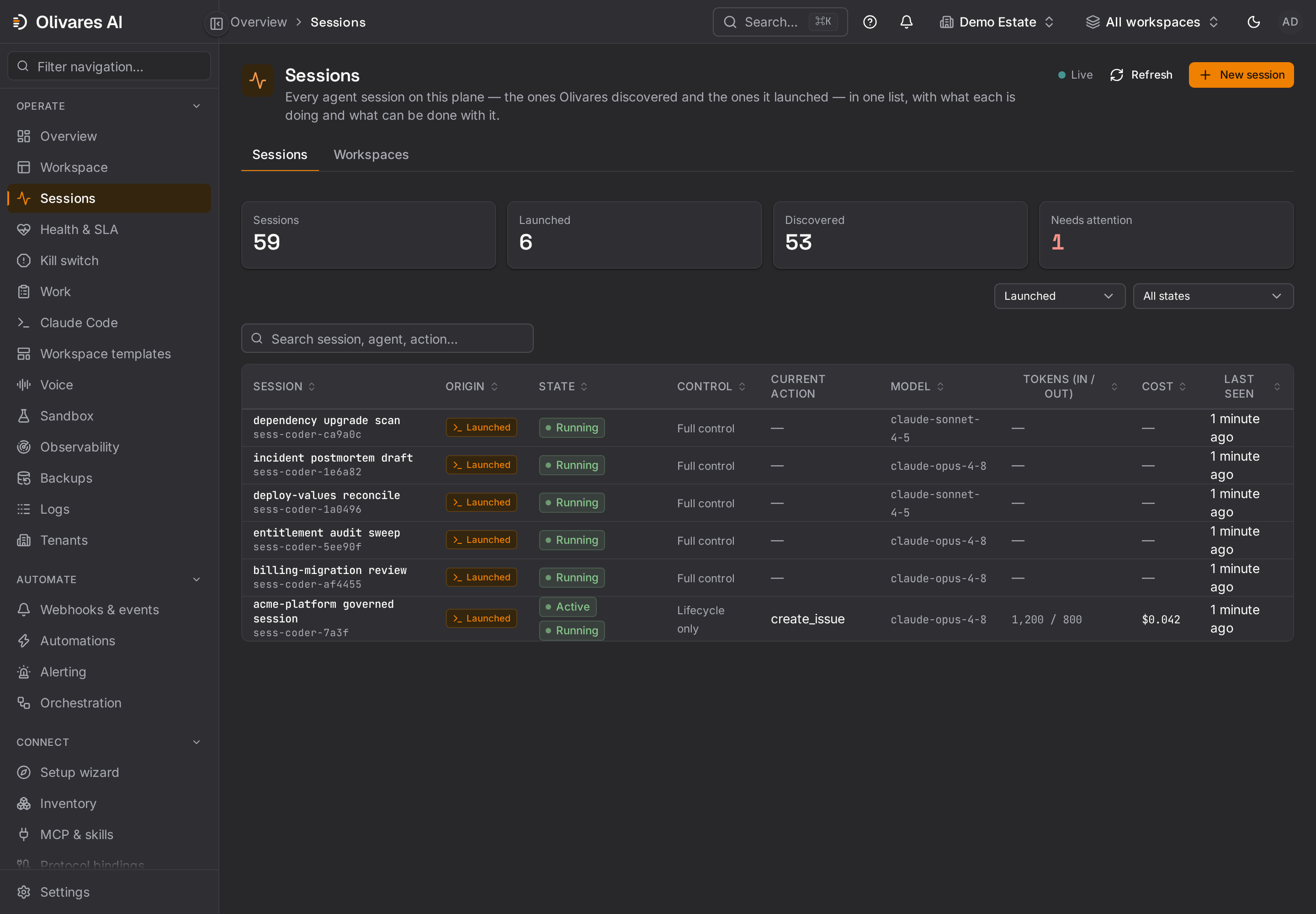
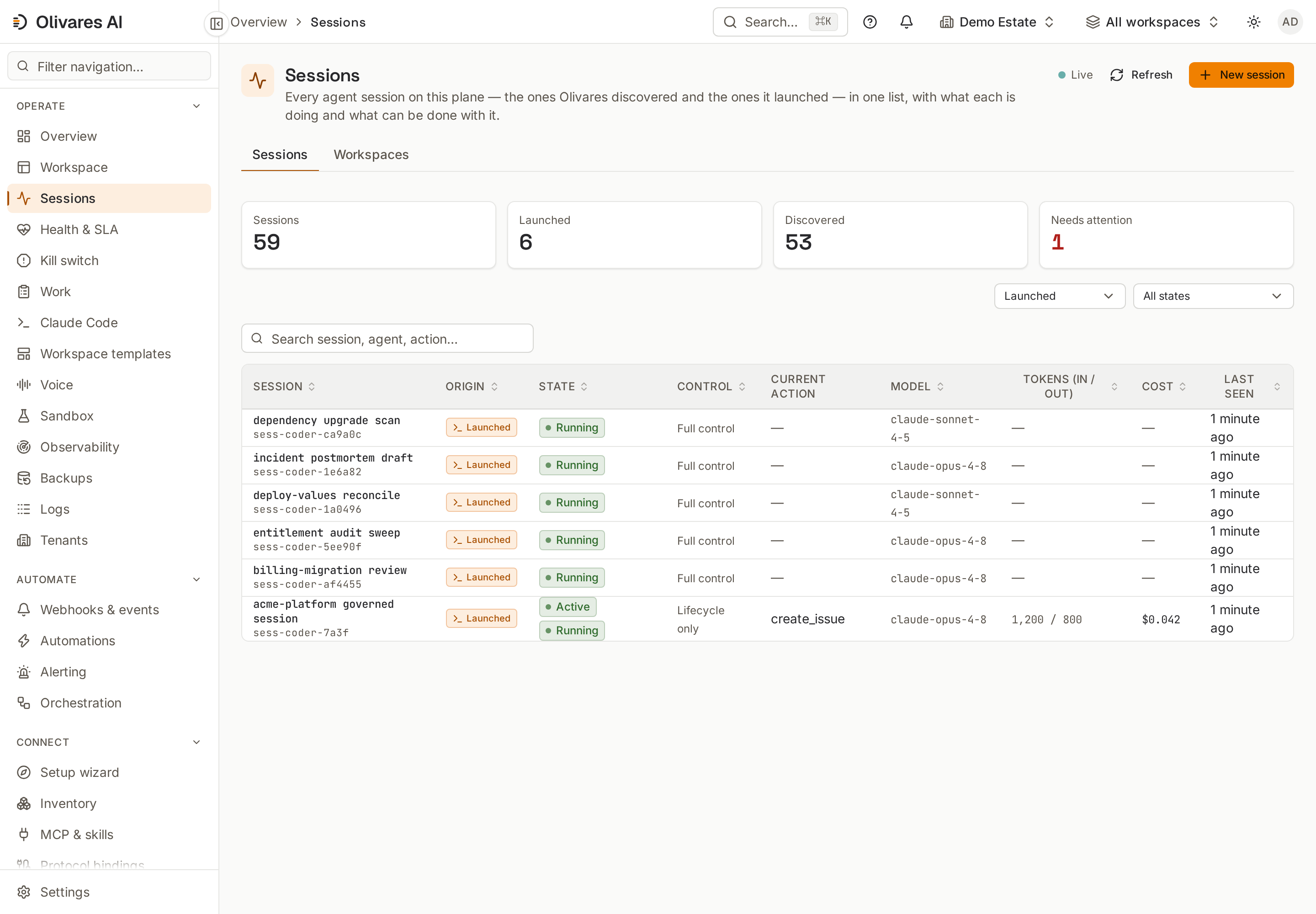
Sessions (/sessions) | Session, state, action, model, tokens, cost, latest activity, and enforced or observed posture. | The posture summarizes event evidence; it is not inferred from registering the connector. |
Access map (/access-map) | R/RW edges attributed from observed tools, MCP, and resources. | An observed edge describes activity; it is not equivalent to prior authorization. |
Cost & FinOps (/finops) | Cost and token samples derived from received telemetry. | Coverage is limited to what the fleet exports; calls that never emitted OTLP cannot be reconstructed. |
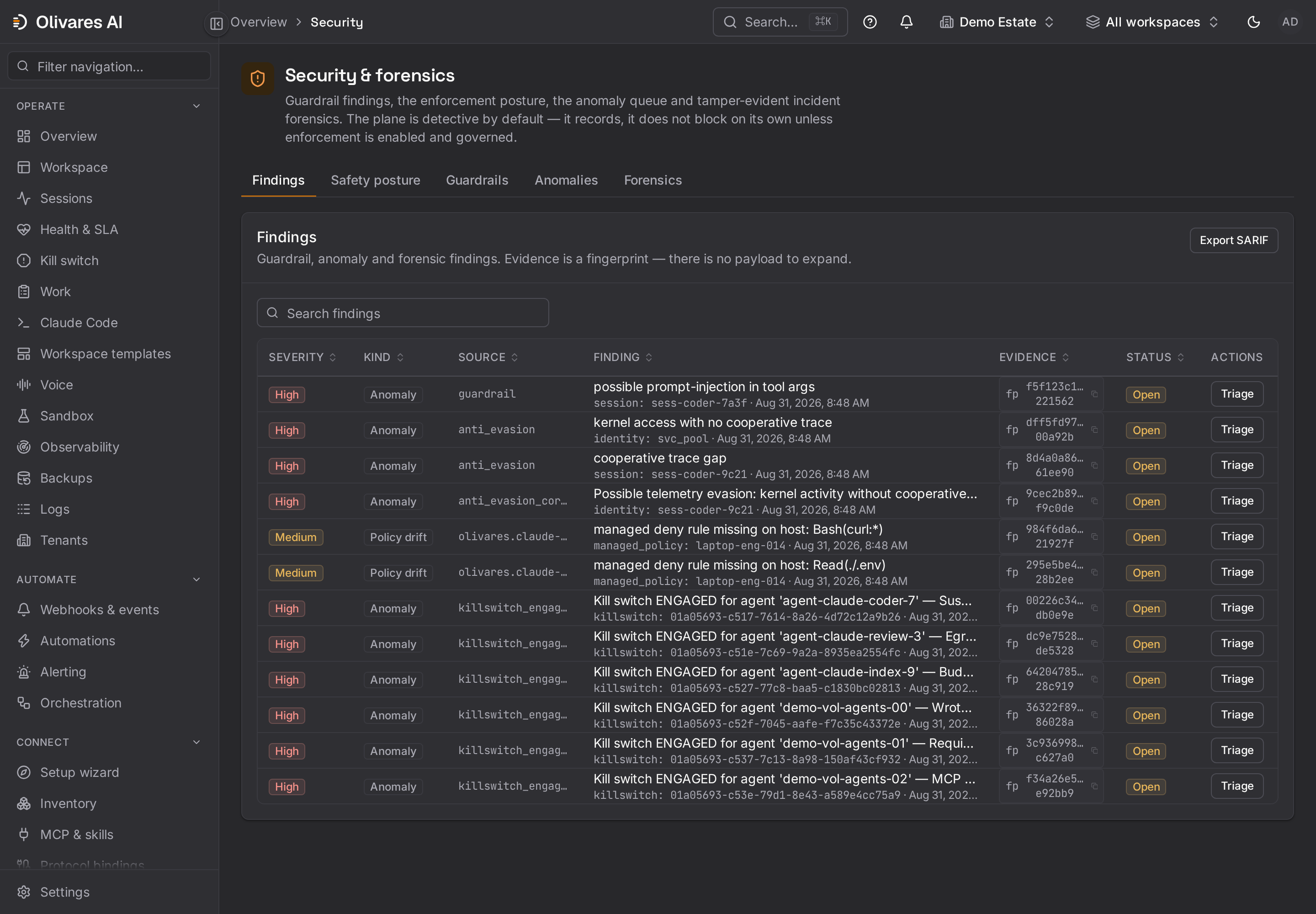
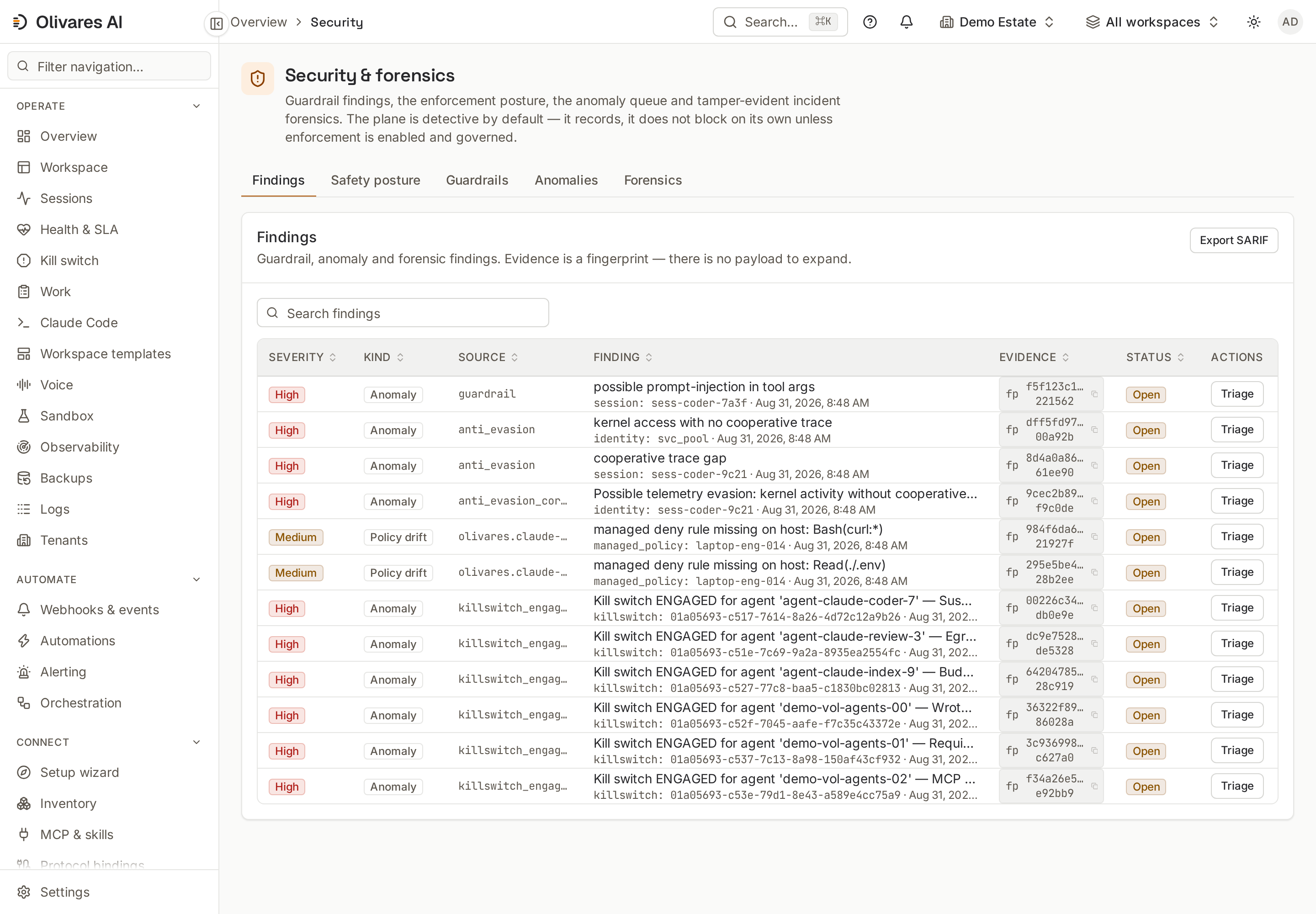
Security (/security) | Telemetry gaps, sandbox/MCP posture, and other emitted findings. | An absent finding does not make an unobserved surface compliant. |
Claude Policy (/claude-policy) | Authoring, distribution, versions, and check-in status for managed Claude Code surfaces. | Distribution and drift verification are separate facts and are shown separately. |
Production use
Section titled “Production use”- Phased rollout: Start with structural content and rules in observed mode with an expiration
date. Review false positives, then promote each tenant to
enforce. - Fleet administration: Distribute
/etc/claude-code/managed-settings.jsonthrough an RPM, immutable image, Ansible, Salt, or the equivalent enterprise configuration manager. Check the live file with a secondmanaged-settingssource to detect absence or drift. - Separation of duties: The platform team maintains receivers and availability; the security
team versions rules; tenant owners review
askrequests and findings. Every privileged change remains attributable. - Data minimization: Keep
content_captureempty unless there is an approved forensic need with defined residency and retention. Structural data is usually sufficient for adoption and cost analysis. - Hardened hosts: Keep receivers on loopback, provide the plugin with a minimal executable
temporary directory, and make the policy read-only. Do not relax
noexecglobally to make the connector start.
What is enforced and what is only observed
Section titled “What is enforced and what is only observed”| Surface | Actual behavior |
|---|---|
OTLP telemetry and the cooperative hook from the claude connector | Observed. The sender cooperates; the loopback receiver does not authenticate, and a local process can omit or fabricate a signal. |
Empty enforcement setting on the source | Observed. This is the default and does not block tools. |
olivares claude-hook + PEP + managed settings | Enforces allow, ask, or deny for events that Claude Code can veto, and records the decision. Endpoint failures deny closed. |
allowManagedHooksOnly in the managed layer | Hardens the installation against user or project hooks that could compete with the PEP. |
PostToolUse | Observes and redacts after the action. It cannot undo effects already produced by the tool. |
| Actions outside the Claude Code process and hook | Not covered by this wiring. Use operating-system controls, native auditing, and network policy as backstops. |
Operational verification requires four separate checks: a persisted roster, an opened connector, an event visible in Ingestion, and a tool actually blocked by the PEP. None of these checks substitutes for the other three.