

Recipe: budgets & FinOps guardrails
Goal: “this team’s agents stop spending at $500/month” — declared once, enforced live, with alert thresholds on the way up.
Budget enforcement is one of the actuations that is live in the default
binary: an enforcing budget at its cap denies the spend with no extra
provisioning (the modules catalog marks it
v1 | v1).
Create a budget
Section titled “Create a budget”curl -ks -X POST "$BASE/v1/m/finops/budgets" \ -H "Authorization: Bearer $TOKEN" -H "X-Olivares-Tenant: $TENANT" \ -H 'Content-Type: application/json' \ -d '{ "dimension": "team", "key": "payments", "limit_micro_usd": 500000000, "period": "monthly", "thresholds": [0.5, 0.8, 1.0], "action": "block" }'- Money is micro-USD (
limit_micro_usd: 500000000= $500), so there is no float ambiguity in the contract. dimension+keyscope the budget. Scoped dimensions includeglobal,model,provider,agent,session,team,project,workspace,api_key,actor,service_tier,context_window,inference_geo,gatewayandidentity.actionis the enforcement mode:
action | At the cap |
|---|---|
alert (default) | showback only — alerts fire, nothing is denied |
throttle | the actuation seam slows new spend |
block | the actuation seam denies new spend |
Budget a single identity
Section titled “Budget a single identity”dimension: "identity" scopes on the external id of a firm roster
identity — the workload or agent identity your
identity sources registered:
{ "dimension": "identity", "key": "spiffe://corp/agent/billing-reconciler", "limit_micro_usd": 50000000, "period": "monthly", "action": "throttle" }The identity is resolved at cost-ingest from the sample’s agent binding, API key or actor — so the budget follows the identity across surfaces, not one API key.
Watch it work
Section titled “Watch it work”# Live consumption vs limit, with run-rate projection:curl -ks "$BASE/v1/m/finops/budgets/$BUDGET_ID/status" \ -H "Authorization: Bearer $TOKEN" -H "X-Olivares-Tenant: $TENANT"
# Threshold crossings (your 50% / 80% / 100% alerts):curl -ks "$BASE/v1/m/finops/alerts" \ -H "Authorization: Bearer $TOKEN" -H "X-Olivares-Tenant: $TENANT"At the cap, an enforcing budget’s check returns allowed: false with the
action (throttle or block) and the budget that fired — the denial names
its reason. Alerts also ride the notification stream, so a Slack or
PagerDuty destination hears the 80%
crossing before the 100% denial.
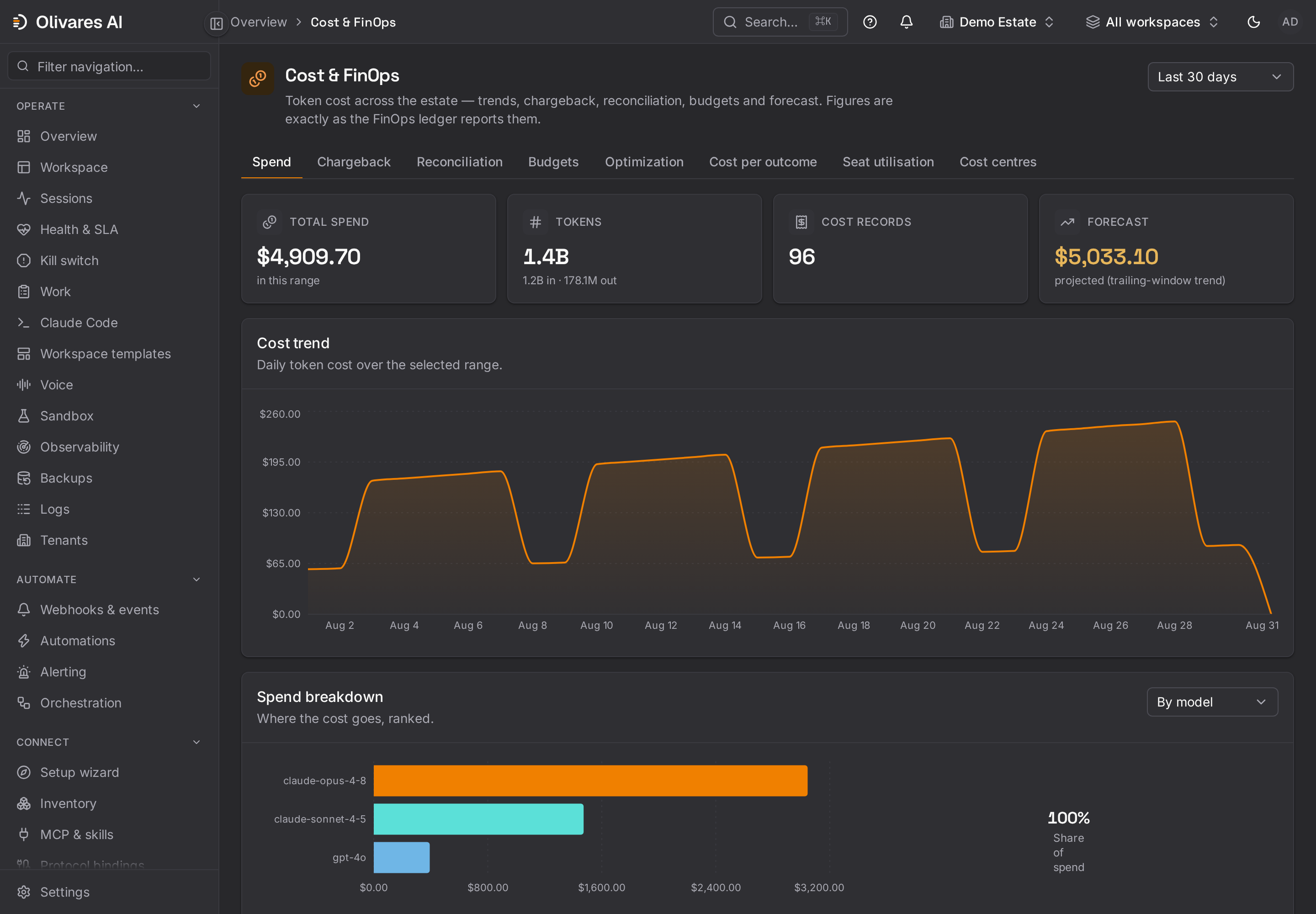
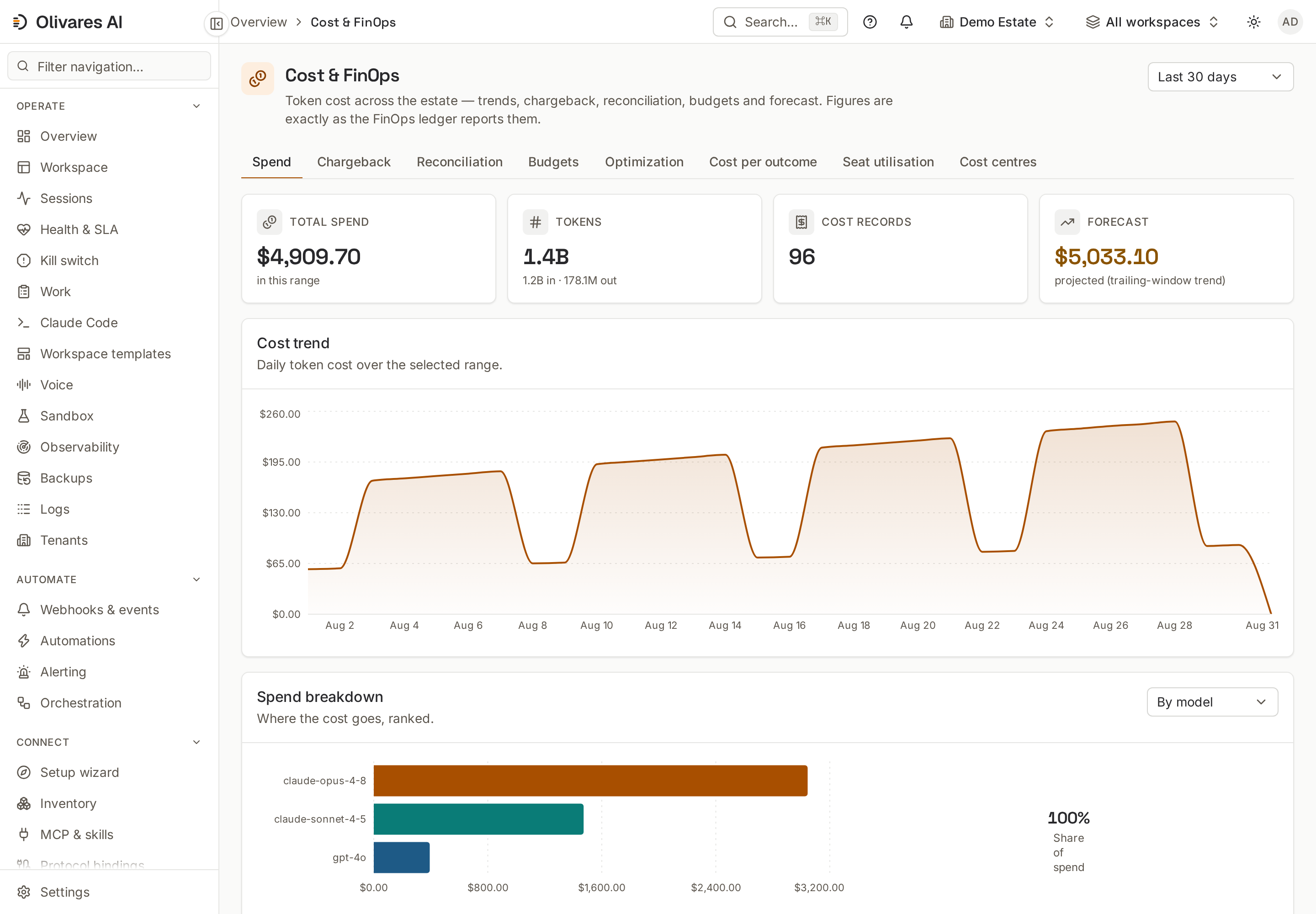
In the console, Cost & FinOps shows spend by dimension with budget status inline:
Give spend a denominator: outcomes
Section titled “Give spend a denominator: outcomes”Cost-per-outcome is what makes a budget a business conversation. Report outcomes (a resolved ticket, a merged PR, a closed case) and read the value panels:
curl -ks -X POST "$BASE/v1/m/finops/outcomes" \  -H "Authorization: Bearer $TOKEN" -H "X-Olivares-Tenant: $TENANT" \  -d '{"kind":"ticket.resolved","subject_ref":"agent:support-triage","count":1}'
curl -ks "$BASE/v1/m/finops/value" \  -H "Authorization: Bearer $TOKEN" -H "X-Olivares-Tenant: $TENANT"
The value summary includes cancellation risk — burn with no outcomes — which is the honest inverse of a success metric.
- Fail-open, deliberately: if the budget check itself errors (a FinOps read failure), inference is allowed rather than silently blocked — a broken meter must not become an outage. The failure is logged and visible.
- Reserved capacity (
reserved_micro_usd) counts toward the limit, so a budget cannot be dodged by pre-booking. cost_typeis deliberately not a budget dimension — estimated-fallback lines ride the dimension they belong to instead of forming a parallel pool.